
Up to 3 Years: Frozen Shoulder Stages, Self-Checks & When Rehab Helps


Frozen shoulder moves through three clinical stages: freezing (painful), frozen (stiff), and thawing (recovery). Pain dominates the freezing stage, stiffness dominates the frozen stage, and gradual improvement marks the thawing stage. The whole course typically runs months to as long as three years, and no two shoulders follow the exact same clock.
TL;DR:
Frozen shoulder typically lasts from several months up to three years, with the freezing stage lasting two to nine months involving increasing pain.
Stiffness becomes the main issue during the frozen stage, with tissue thickening and reduced pliability, lasting several months.
Recovery in the thawing stage can take five months to two years, with gradual improvements in motion and function, sometimes incomplete.
Active and passive range of motion restrictions are usually symmetrical, and symptoms that worsen steadily suggest freezing, while plateaued stiffness indicates the frozen stage.
Risk factors include diabetes, thyroid disease, prolonged immobilization, prior shoulder injuries, and it is more common in middle-aged adults and women.
Table of Contents
What Happens in Each Stage of Frozen Shoulder?
Every stage of adhesive capsulitis tells a different story inside the joint, and knowing which chapter you’re in changes what kind of care actually helps.
Freezing stage. This is where the ache starts creeping in, often worse at night, and it tends to build over weeks rather than appearing overnight. Inside the joint capsule, inflammation and synovitis are taking hold. According to Mayo Clinic, this phase typically lasts two to nine months. Reaching overhead or behind your back starts to hurt before it starts feeling stuck, which is a distinction worth remembering.
Frozen stage. Here the pain often eases off a notch, but the shoulder tightens up considerably. Reaching for a seatbelt, washing your hair, or tucking in a shirt in back becomes genuinely hard. The tissue changes explain why: arthroscopic and histologic studies show the joint capsule shifting from an inflamed, hypervascular state into dense collagenous fibrosis, essentially thickened, less pliable tissue that resists stretching. This stage generally runs for a period lasting several months.
Thawing stage. Motion returns, slowly and sometimes maddeningly so. Function improves over a stretch that can run anywhere from five months to two years, per Mayo Clinic’s data. Some patients recover full range of motion; others land at a slightly reduced ceiling that still lets them do everything they need to do.
Freezing: progressive pain, worse at night, motion still fairly preserved early on
Frozen: pain plateaus or drops, stiffness becomes the main obstacle
Thawing: motion and function return gradually, though not always completely
Orthopedic surgeons sometimes use a more detailed four-stage arthroscopic classification that maps directly to what they see inside the joint during a scope. It’s a useful clinical detail, but for the person living in the shoulder, the three-stage model is the one that actually matches daily experience.
Pro Tip: Track your pain and your motion separately on a simple 1 to 10 scale each week. Watching them diverge, pain dropping while stiffness holds steady, is often the clearest sign you’ve crossed from freezing into frozen.
How Do You Know Which Stage of Frozen Shoulder You’re In?
The single most useful clue is which symptom is running the show: pain or stiffness. A pain-dominant presentation, where sharp discomfort limits movement more than actual joint restriction, usually points to the freezing stage. A stiffness-dominant presentation, where the joint feels physically blocked even when pain is manageable, points toward frozen.
A quick self-check can sharpen that read:
Try lifting your arm out to the side (active abduction) and note where it stops.
Have someone gently lift that same arm for you (passive abduction) and compare the range.
Attempt rotating your arm outward with your elbow bent at your side (external rotation), both on your own and with assistance.
In true adhesive capsulitis, active and passive motion are restricted by roughly the same amount. That’s the diagnostic signature clinicians rely on, and it’s what separates frozen shoulder from problems like a rotator cuff tear, where passive motion often stays close to normal even when active motion is painful and limited.
Timeline matters too. Symptoms that have been building for weeks and getting steadily worse suggest freezing. Stiffness that has plateaued for months without much pain suggests frozen. Gradual, month-over-month gains suggest thawing.
Imaging usually isn’t needed to diagnose frozen shoulder itself, but a clinician may order an X-ray or MRI to rule out arthritis, a labral tear, or a rotator cuff problem, especially if symptoms don’t fit the expected pattern.
Seek prompt evaluation if you notice: sudden severe pain after a fall or injury, numbness or weakness down the arm, fever, or visible joint deformity. Those point away from a routine frozen shoulder and warrant urgent attention.
What Causes Frozen Shoulder and Who’s at Risk?
Frozen shoulder rarely comes out of nowhere. It clusters around a handful of well-documented risk factors, and understanding them explains a lot about why some people’s shoulders lock up while others sail through minor shoulder injuries without issue.
Diabetes is one of the strongest risk factors identified in the clinical literature, likely tied to how elevated blood sugar affects collagen in connective tissue.
Thyroid disease, both underactive and overactive, shows up disproportionately often in people who develop the condition.
Prolonged immobilization, say, an arm in a sling after surgery or a fracture, is a well-known trigger. Since the joint doesn’t move, the capsule can tighten on its own.
Prior shoulder trauma or surgery raises risk considerably, even after the original injury has healed.
The condition is also more common in middle-aged adults and in women more than men. At the tissue level, it starts as inflammation of the joint capsule’s synovial lining, then slowly hardens into fibrous scar tissue that physically restricts movement. That biology, inflammation giving way to fibrosis, is exactly why early pain control and later stretching require such different approaches.
How Is Frozen Shoulder Diagnosed and What Mimics It?
Frozen shoulder is diagnosed almost entirely through a hands-on exam, not a scan. The hallmark clinicians look for is restricted active and passive range of motion, meaning the shoulder resists movement whether you’re moving it yourself or someone else is moving it for you. That symmetry between active and passive loss is what sets true adhesive capsulitis apart from most other shoulder problems.
Imaging enters the picture mainly to rule things out, not rule frozen shoulder in:
X-rays help exclude arthritis or a bone spur that might be mimicking the symptoms.
MRI helps identify a rotator cuff tear, labral damage, or other soft-tissue injury when the exam findings are ambiguous.
Common mimics include rotator cuff tears (usually preserved passive motion), shoulder osteoarthritis (grinding or catching sensations, X-ray changes), and cervical spine issues that refer pain into the shoulder without any real joint restriction. A careful clinician sorts through these by comparing active versus passive motion loss and by asking how the pain behaves over time, since each mimic tends to follow its own distinct pattern.
What Treatments Match Each Stage of Recovery?
Treatment for frozen shoulder isn’t one-size-fits-all. It shifts as the joint itself shifts, from calming inflammation early to breaking up stiffness later, and matching the approach to the stage tends to produce better results than a generic exercise handout.
During freezing: the priority is pain control, not aggressive stretching. Options include NSAIDs, a short course of corticosteroid injection, gentle range-of-motion movement, and simple sleep adjustments (a pillow wedge or sleeping on the opposite side) to ease night pain. Harvard Health recommends starting home range-of-motion exercises early rather than waiting for pain to fully resolve.
During frozen: targeted stretching and supervised physical therapy move to the front. For people whose function is severely limited, a corticosteroid injection or a manipulation procedure under anesthesia may be considered.
During thawing: the focus shifts to progressive strengthening and rebuilding the movements needed for daily life, reaching overhead, buttoning a shirt, tucking a wallet into a back pocket. Gains often come slowly, and setting realistic expectations here matters as much as the exercises themselves.
Pain control (freezing) → stretching and PT (frozen) → strengthening and function (thawing)
Manipulation under anesthesia or arthroscopic capsular release are reserved for cases that don’t respond to months of appropriately staged conservative care
Avoid prolonged immobilization after any shoulder injury; that “just rest it” instinct is one of the more common paths into a frozen shoulder in the first place
Pro Tip: If a home exercise plateaus for more than three or four weeks with zero change in your passive range of motion, that’s usually the signal to bring in a physical therapist rather than push harder on your own.
What Research Says About Recovery Variability
Recent review evidence treats the three-stage model as a useful teaching framework, not a strict clock. Many patients have symptoms that stretch well past the textbook “thawing” window, and stage boundaries often blur together. The practical takeaway: expect gradual improvement, but plan for a course that may run longer than any chart suggests.
What a Rehab-Focused Team Wants You to Know
Progress in frozen shoulder is rarely linear, and that’s normal, not a sign something’s wrong. We encourage patients to track small functional wins, reaching a shelf, sleeping through the night, rather than fixating on full range of motion. If motion stalls despite consistent home exercises, or daily tasks stay hard, a coordinated team, your doctor, orthopedics, and hands-on rehabilitation care, can help move things along.
— James
How Chirocompassion Can Help When Stiffness Won’t Budge
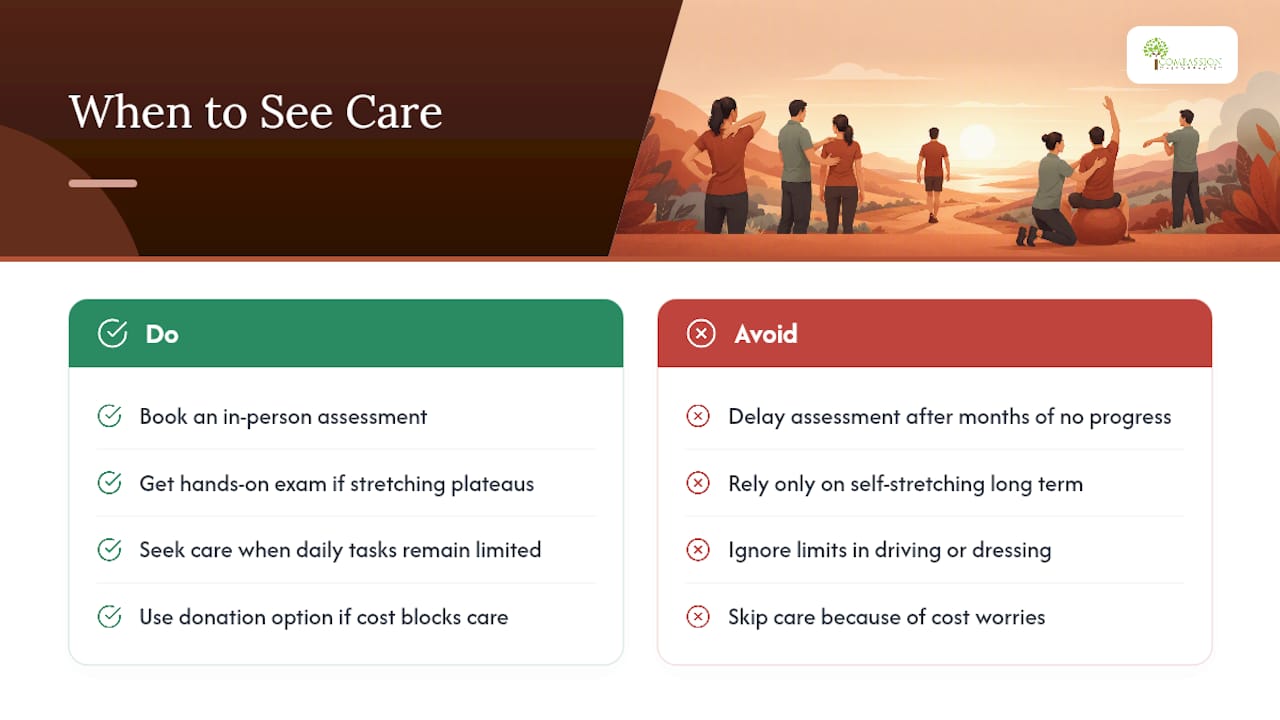
If home stretching has plateaued and everyday tasks like reaching overhead or tucking in a shirt are still a struggle, an in-person assessment can pinpoint exactly which stage your shoulder is stuck in and why. Chirocompassion built its model around removing that decision friction: walk-in visits, no lengthy scheduling wait, and a donation-based option so cost never keeps someone out of care they need.

At the clinic, an assessment and diagnosis visit maps your current range of motion against what’s expected for your stage, then a plan pulls from neuromuscular rehabilitation, ultrasound and electrotherapy for pain and tissue mobility, and cryotherapy for inflammation control. These modalities work alongside guided mobility programs designed to move you toward function, not just less pain. If you’ve been managing alone for months with limited gains, or daily activities like driving, dressing, or sleeping are still compromised, that’s a reasonable signal to get hands-on eyes on the joint.
You can see the full range of chiropractic adjustment and rehabilitation services offered, or go ahead and book an assessment online to get a clear read on where your shoulder stands and what stage-appropriate care looks like next.
Sources
For deeper clinical detail beyond this guide, consult StatPearls on adhesive capsulitis for pathophysiology and risk factors, Mayo Clinic’s frozen shoulder overview for staging and duration, AAOS OrthoInfo for diagnosis and treatment escalation, and the Nature Reviews Disease Primers paper for a research-level view of variability and prognosis.
This article is general information, not a substitute for advice from a qualified doctor. Consult a qualified healthcare professional about your own circumstances before acting on anything here.
FAQ
How do you know which stage of frozen shoulder you’re in?
Compare your active and passive range of motion, both restricted similarly points to frozen shoulder, and note whether pain or stiffness dominates. Rising nighttime pain with fairly preserved motion suggests freezing; plateaued pain with major stiffness suggests frozen, and gradual month-over-month improvement suggests thawing.
What’s the fastest way to heal a frozen shoulder?
There’s no true shortcut, since the capsule needs time to move from inflammation to fibrosis to remodeling. Starting gentle range-of-motion work early, following stage-appropriate physical therapy, and controlling pain with NSAIDs or a steroid injection when needed tend to produce the best outcomes.
What gets mistaken for frozen shoulder?
Rotator cuff tears, shoulder osteoarthritis, and referred pain from the cervical spine are the most common mimics. The key distinguishing sign is that true frozen shoulder restricts both active and passive motion equally, while a rotator cuff tear often still allows fairly normal passive movement.
What can trigger a frozen shoulder?
Prolonged immobilization after an injury or surgery is a common trigger, along with diabetes, thyroid disease, and prior shoulder trauma. Some cases develop with no clear trigger at all, which is part of why the condition is still not fully understood.
Does Chirocompassion offer treatment for frozen shoulder stiffness?
Chirocompassion offers assessment and diagnosis, neuromuscular rehabilitation, ultrasound, electrotherapy, and cryotherapy that can support stage-appropriate mobility recovery. Current pricing and service details are available on the Chirocompassion services page.
Recommended
Comments