
Ice 48–72 Hours, Then Heat: Clinic Backed Rules

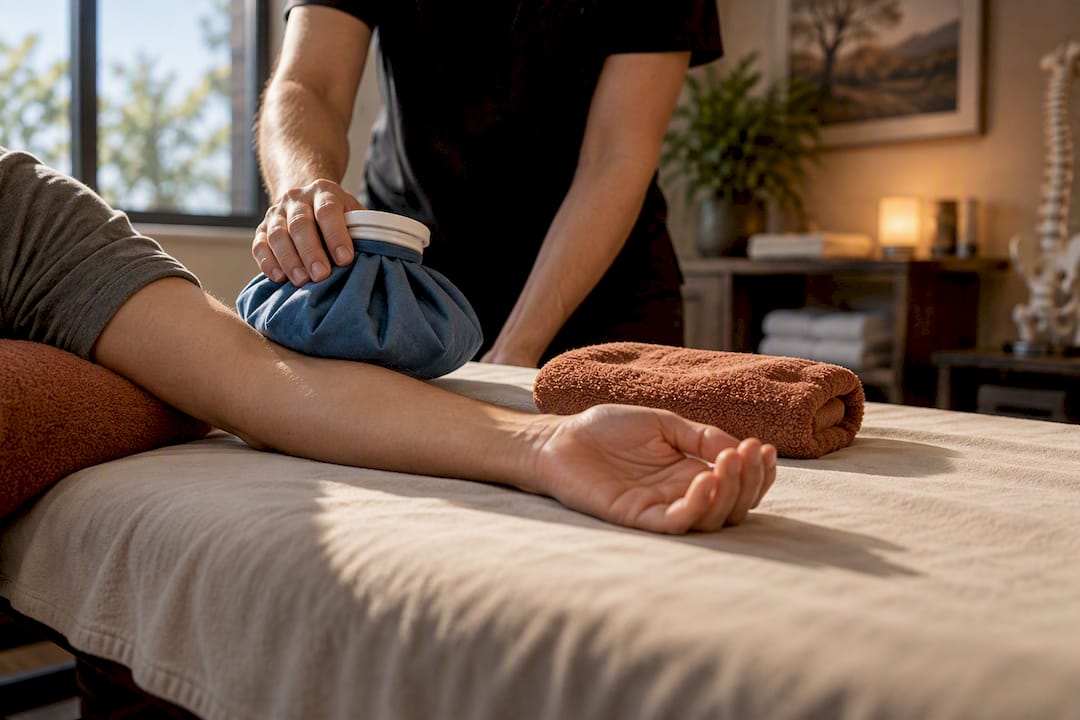
Use ice for fresh swelling, active bleeding, or the sharp pain of a brand-new injury. Reach for heat once swelling has settled and what’s left is stiffness or chronic muscle tension. Both are short-term comfort tools, not cures, so pay attention to the safety checks and warning signs before you rely on either one for long.
TL;DR:
Cold therapy is most effective within the first 48 to 72 hours after injury to reduce swelling and pain, but it does not necessarily speed up tissue healing.
Heat should only be used once swelling and redness have settled, as it increases blood flow and can worsen inflammation if applied prematurely.
When applying ice or heat, use a barrier and limit sessions to 15 to 20 minutes, checking skin condition to avoid burns or frostbite.
Contrasting hot and cold therapy may provide temporary relief, but protocols vary widely and lack consistent scientific support.
Persistent or severe symptoms require professional evaluation, as home treatments cannot address underlying causes or offer a definitive diagnosis.
Table of Contents
Heat vs Ice: When Cold Therapy Is the Right Call
Cold works by narrowing blood vessels near the skin, which slows local blood flow and dulls the nerves that carry pain signals. That combination makes ice genuinely useful in the window right after trauma, when your body’s inflammatory response is just getting started.
Think of a rolled ankle, a fresh hamstring pull, or a bruised knee still swelling an hour after you hit it. Ice, wrapped and applied promptly, curbs that swelling and takes the edge off the pain enough to let you rest the area.
What the research actually shows: cryotherapy studies for soft-tissue injuries report real short-term relief and some benefit for ankle sprains and post-surgical recovery, but the overall evidence stays mixed because trial quality varies so much. Ice calms symptoms; it doesn’t necessarily speed the underlying repair.
Cold isn’t for everyone, either.
Skip ice if you have impaired skin sensation or nerve damage that would keep you from noticing frostbite forming.
Avoid it with peripheral vascular disease, since restricted circulation makes cold exposure riskier.
Cold urticaria and Raynaud’s disease both call for a conversation with a clinician before you apply anything cold to the skin.
Heat vs Ice: When Warmth Helps Chronic Pain and Stiffness
Heat does almost the opposite of ice. It widens blood vessels, pulls more circulation into the tissue, loosens tight muscle fibers, and raises your local pain threshold. That’s exactly what a stiff, aching muscle needs, but only once the acute inflammation has had time to calm down.
Picture a low back that’s been tight for two weeks, a frozen shoulder that won’t loosen up in the morning, or hamstrings that stay locked after yesterday’s long drive. None of those are actively swollen or hot to the touch, and that’s the tell that heat is the better fit.
Safety threshold worth remembering: a heating device can raise tissue temperature by roughly 9 to 12 degrees Fahrenheit, and skin contact above 113°F starts to feel painful, with real burn risk climbing past 122°F. Warm, not hot, is the goal.
Never apply heat to an area that’s actively swollen, red, or warm to the touch, since it can pull in more blood flow and make inflammation worse rather than better.
How to Apply Ice and Heat Safely at Home
Getting the timing and technique right matters as much as picking the correct modality in the first place.
Wrap ice or a gel pack in one or two layers of thin towel. Never let ice sit directly on bare skin.
Apply for 15 to 20 minutes at a stretch, repeating several times a day during the first 48 to 72 hours after an acute injury.
For heat, moist heat (a warm, damp towel or a hydrocollator pack) tends to penetrate better than dry heat.
Keep a barrier between any heating device and your skin, and check the skin after about five minutes to make sure it’s warming, not burning.
Follow the device’s own time limits rather than guessing, and never use a heating pad on a swollen, hot, or red area.
Skip the microwave shortcut for gel packs unless the packaging specifically allows it. Overheated packs are a common source of skin burns.
Pro Tip: Use short ice sessions to quiet pain just enough for gentle, pain-limited movement, rather than numbing the area so thoroughly that you lose track of how the injury actually feels. Pain that vanishes completely under ice can mask symptoms you need to be monitoring.
When Should You Switch From Ice to Heat?
Let your symptoms drive the decision instead of the calendar. If swelling, warmth, or a throbbing quality is still present, keep icing. Once that swelling has visibly settled and what remains is tightness or stiffness without heat or throbbing, heat becomes the better tool.
Ongoing swelling, redness, or throbbing: stick with cold.
Swelling gone, but the area feels tight or stiff: heat is reasonable to try.
Heat makes the area throb more or swell again: stop and go back to ice, and consider getting it checked.
Alternating hot and cold, often called contrast therapy, has become popular partly through the cold plunge after sauna trend, and some people do report feeling temporary relief from cycling between the two. The research behind it, though, is inconsistent: study protocols vary wildly in temperature, duration, and sequence. No one has established a standardized routine that reliably speeds recovery. If you try a sauna then cold plunge sequence, keep the cycles modest, avoid extreme temperatures, and stop the moment symptoms get worse rather than better.
What the Evidence Actually Says About Hot and Cold Therapy
Ice delivers real, short-term pain relief, and that part of the research is solid. What’s less certain is whether it meaningfully speeds tissue healing over the following weeks.
Cochrane’s review of low back pain treatments found moderate evidence that heat wraps produce a small, short-term reduction in pain and disability for cases under three months old, while evidence supporting cold for low back pain specifically was judged insufficient.
Contrast therapy trials remain heterogeneous in design, with no consistent protocol proven to outperform simpler heat or ice alone.
Neither modality replaces an actual diagnosis. They’re meant to sit alongside exercise, rehabilitation, and, when needed, hands-on care.
One detail that surprises a lot of people: human muscle studies suggest topical cooling often doesn’t reach deep muscle tissue the way it does in animal research, which means ice may work best on injuries close to the skin’s surface rather than deep muscle strains.
When to Stop Self-Treating and See a Clinician
Some symptoms need more than a towel and an ice pack.
Get urgent care for a visible deformity, inability to bear weight, rapidly worsening swelling, severe pain that isn’t easing, numbness or weakness, a pale or cold limb, an open wound, or fever.
Book an appointment (not urgent care) for pain that lingers past a few days, swelling that keeps returning, a range of motion that isn’t improving, or a diagnosis you’re still unsure about.
A clinician can add what a heating pad can’t: an actual diagnosis, imaging when warranted, and a supervised rehab plan built around your specific injury.
A Clinician’s Note on Heat, Ice, and Real Recovery
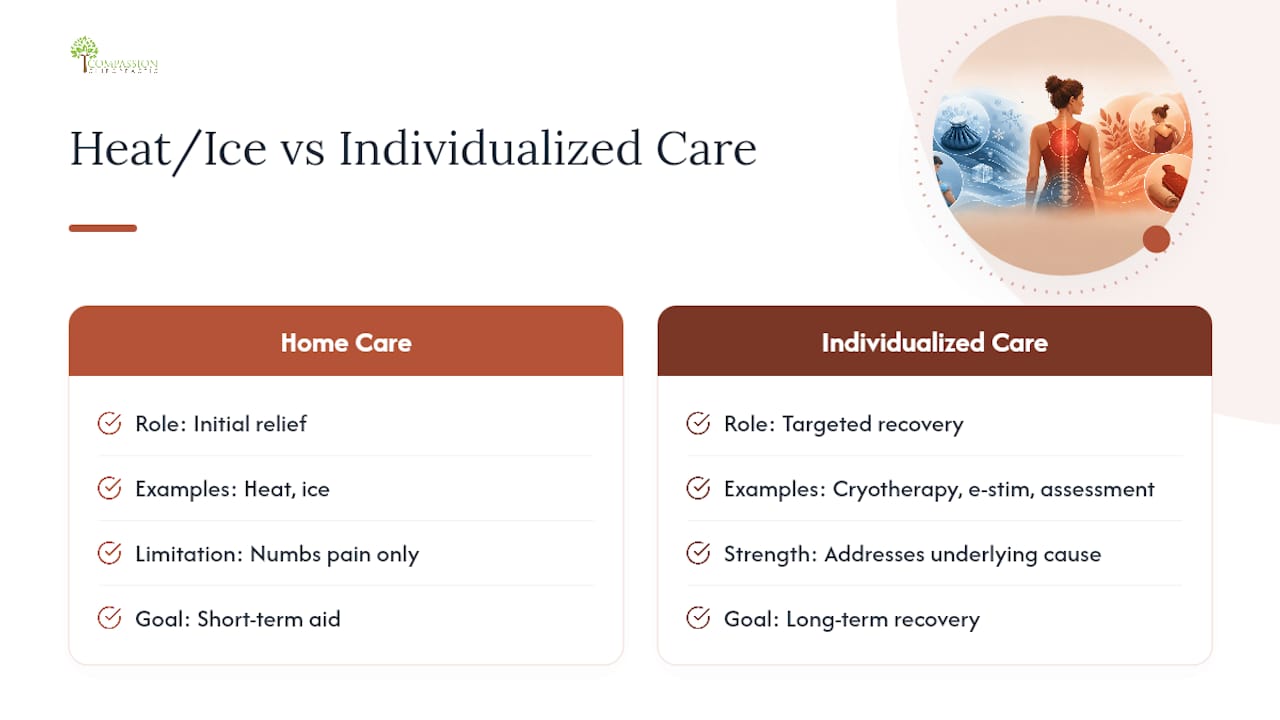
Home heat and ice have their place, but at Compassion Chiropractic we treat them as a starting point, not a treatment plan. What we’ve seen matters more is pairing that home care with an individualized recovery approach, whether that means supervised cryotherapy, electrotherapy, or simply a proper assessment of what’s actually causing the pain.
Numbing an ache isn’t the same as fixing it, and that gap is where a lot of people get stuck longer than they need to.
— James
Get an In-Person Assessment at Compassion Chiropractic
Ice and heat can quiet a symptom for an afternoon. What they can’t do is tell you why your back keeps tightening up or why that ankle still swells three weeks after the sprain. Since 2009, Compassion Chiropractic has offered affordable, personalized chiropractic care built around walk-in access, so you don’t have to wait weeks for someone to actually look at what’s going on.

Beyond adjustments, the clinic offers rehabilitation-focused therapies that pick up right where home ice and heat leave off, including cryotherapy, electrotherapy and ultrasound, and infrared sauna sessions as part of a broader service lineup. If your pain has stuck around longer than a few days, or you’re not sure whether it calls for ice, heat, or something more, book an exam online and get a plan built around your actual injury instead of another guess.
Sources
This article is general information, not a substitute for advice from a qualified doctor. Consult a qualified healthcare professional about your own circumstances before acting on anything here.
FAQ
Why Is Heat Not Good for Swelling?
Heat widens blood vessels and increases circulation to the area, which can pull in more fluid and make active swelling worse rather than better. Save heat for once swelling has visibly settled and stiffness is the main issue left.
Why Is Ice No Longer Recommended for Some Injuries?
Ice still has solid support for short-term pain relief, but reviews of the research on soft-tissue injuries show its effect on long-term healing is limited and inconsistent. It’s best understood as a symptom-control tool rather than something that accelerates tissue repair.
At What Point Do You Switch From Ice to Heat?
Switch when the swelling, warmth, or throbbing has clearly settled and what remains is tightness or stiffness. If heat brings the throbbing or swelling back, stop and return to ice, and consider getting the injury checked.
Should I Use Heat or Ice on a Sprained Ankle?
Use ice in the first 48 to 72 hours after a sprain while swelling is active, wrapping it with a towel barrier for 15 to 20 minute sessions. Once the swelling has gone down and only stiffness remains, heat can help loosen the joint before movement.
Can a Chiropractor Help Beyond Home Heat and Ice?
Yes. A clinician can diagnose what’s actually causing your pain and build a supervised recovery plan, and Compassion Chiropractic offers walk-in exams along with rehabilitation-focused therapies; current pricing is available on the site.
Recommended
Comments