
6 Daily Active Hip Mobility Exercises, All Planes & Clinician Options

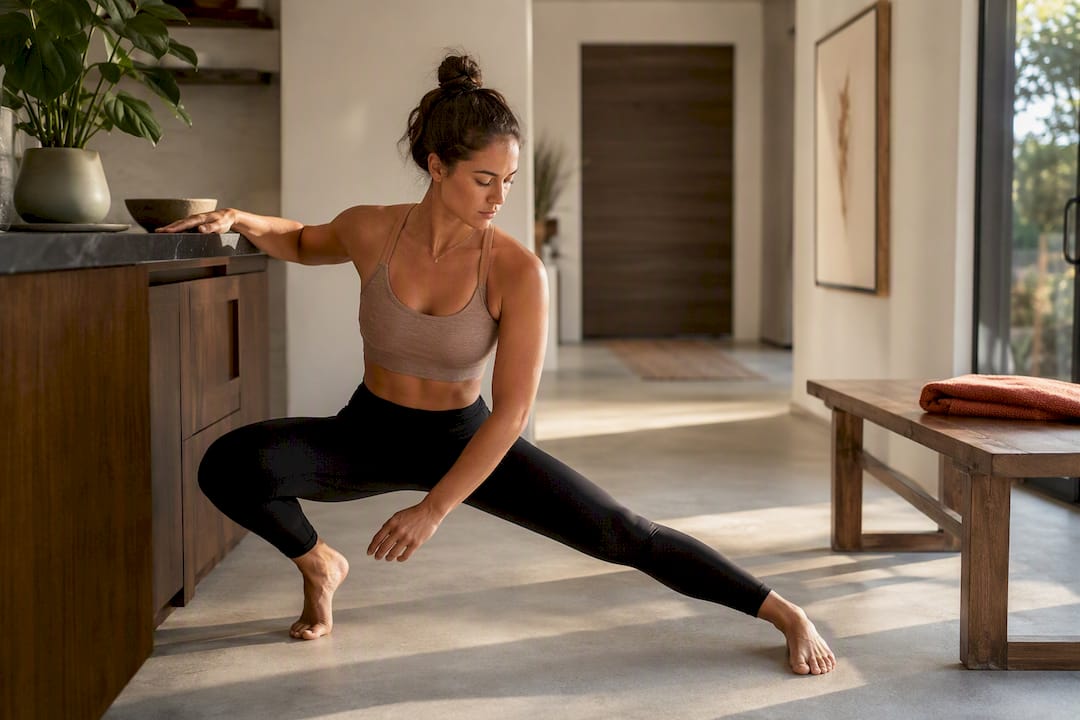
A short daily routine of active hip mobility exercises, done for a few minutes, is the fastest way to loosen stiff hips and move better in daily life. Start with 90/90 rotations, groiners, and hip circles, working through rotation, side-to-side, and forward-back motion. Many people report less morning stiffness and improved squatting depth with consistent daily practice over a few weeks.
TL;DR:
Hip mobility exercises should incorporate rotations in all three planes to achieve more functional improvements than focusing solely on forward and backward motion.
Doing these routines daily or at least five times a week enhances lasting results, especially when combining dynamic movements with end-range isometric holds.
Proper technique in drills like 90/90 rotations and windshield wipers is crucial, including keeping hips squared and avoiding pelvis tilting for maximum benefit.
Pain or numbness during exercises warrants stopping and consulting a healthcare professional, especially if symptoms persist beyond a few weeks of consistent practice.
Combining active mobility work with manual therapy and corrective strengthening yields faster and more durable improvements than stretching alone.
Table of Contents
Why Hip Mobility Matters More Than You Think
Hip mobility is simply how freely your hip joint moves through its full range without pain or restriction, and it touches almost everything you do. Walking up stairs, getting off the floor with your grandkids, swinging a golf club, sprinting for a bus. When that joint gets stiff, your lower back and knees usually pick up the slack, which is how a “tight hip” turns into chronic back pain nobody saw coming.
Your hip moves in three planes, and most people only train one of them. Forward and backward motion, called the sagittal plane, gets plenty of attention from squats and lunges. Side-to-side motion, the frontal plane, and rotation, the transverse plane, get almost none. That gap matters because training all three planes together produces more functional improvement than stretching in just one direction, and rotation is the piece most people are missing entirely.
Here’s what a well-rounded hip mobility program actually delivers:
Easier, deeper squats without knee compensation
Reduced lower back tightness from prolonged sitting
Better balance and less risk of falls, especially for older adults
More efficient stride length for walking, running, and hiking
Smoother rotational power for golf, tennis, and throwing sports
Static stretching alone, the kind where you hold a pose and wait, tends to fade fast. Active mobility work, where you move through the range under your own control, tends to stick because you’re training your nervous system to trust that range, not just your muscles to lengthen for a moment.
Your 5 to 10 Minute Starter Hip Mobility Routine
This is the flow to do first thing in the morning, before a workout, or during a work break. No equipment. No mat required, though a mat makes the floor work more comfortable.
Move through each drill for about half a minute to one minute, breathing steadily through your nose, and complete one to two full rounds. The whole routine takes several minutes depending on how many rounds you do.
Quadruped hip circles — On hands and knees, lift one knee and draw a big circle with it, five circles each direction, then switch sides.
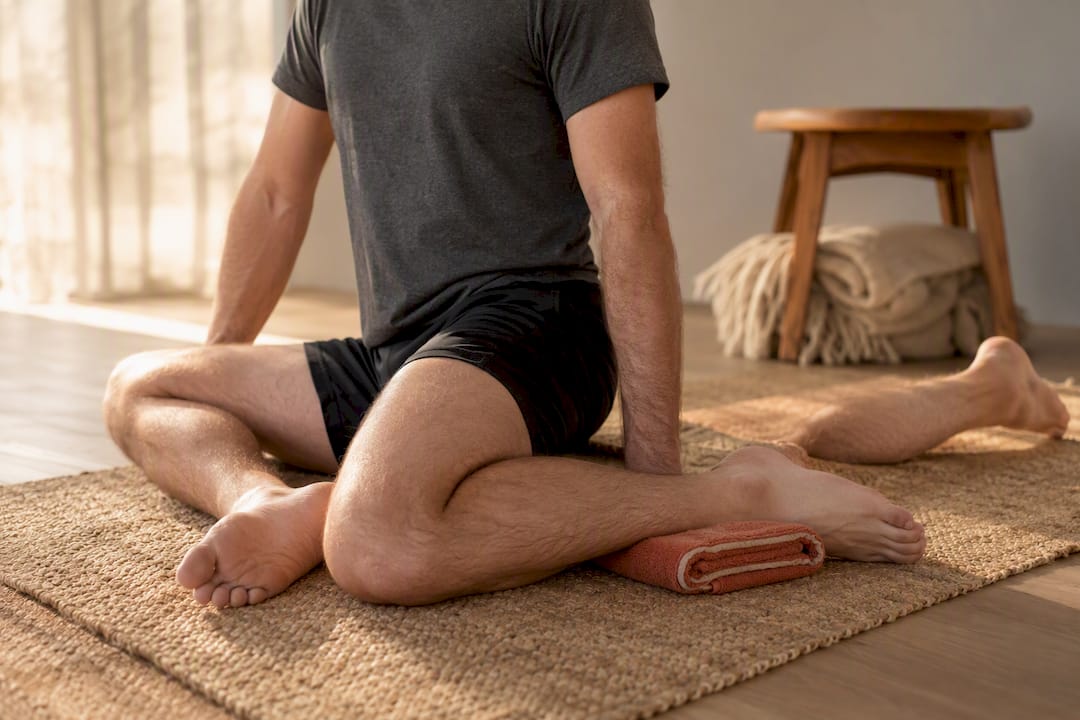
90/90 rotations — Sit with one leg bent in front at 90 degrees and the other bent behind at 90 degrees, then rotate both knees to the opposite side without using your hands. Aim for 8 to 10 slow reps per side.
Groiners (windshield wipers) — From a low lunge or plank position, rock your hips side to side or sweep bent knees left and right on the floor, 30 to 45 seconds.
Cossack squat (or side-to-side squat) — Step wide, shift your weight into one bent knee while the other leg straightens, then reverse. Eight reps per side.
Pigeon-to-frog alternation — Move from a pigeon stretch into a wide frog stretch and back, holding each position for 5 to 8 seconds, for about 45 seconds total.
Deep squat active hold — Sink into the lowest squat you can control, elbows pressing knees outward, and hold for 30 to 45 seconds while gently rocking.
This exact combination, mixing rotation drills like 90/90s with pigeon and windshield wipers, is backed by physicians as a way to counter the stiffness that builds up from a day of sitting.
Pro Tip: If your knees complain during 90/90s or pigeon, fold a towel under the down knee. It removes the pressure without removing the stretch.
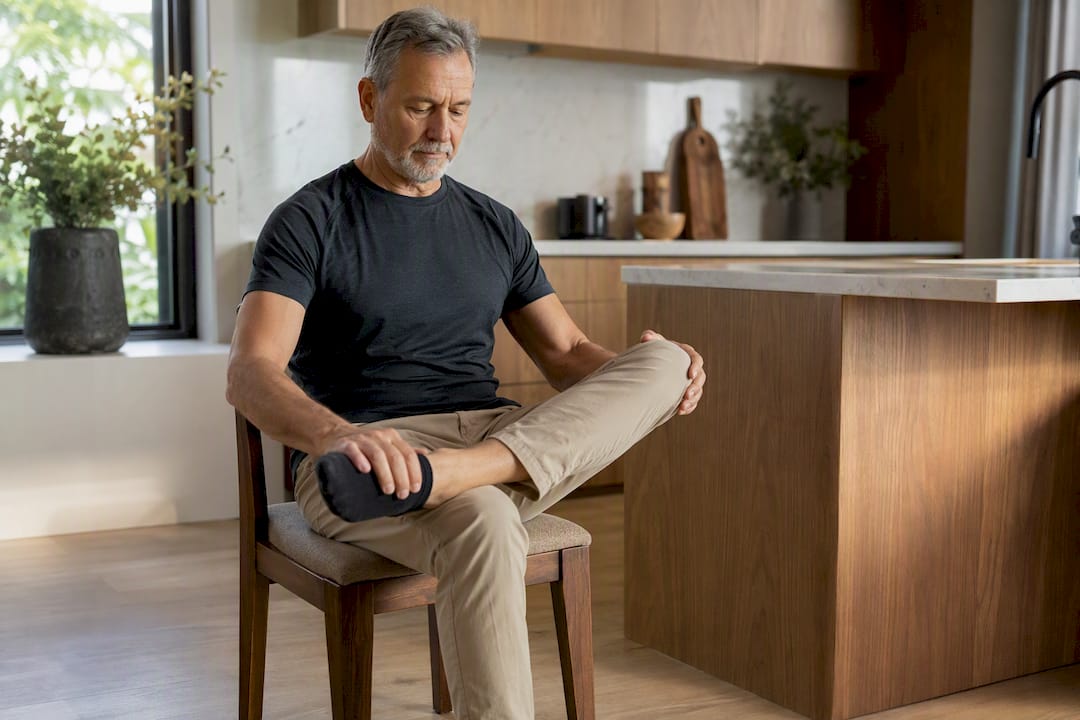
If you’re a beginner, recovering from a layoff, or working with limited mobility, drop the quadruped and deep squat holds and do a chair-supported version instead: seated hip circles, seated figure-four stretches, and standing Cossack steps holding onto a countertop for balance. Shorter holds of 15 to 20 seconds are fine to start.
Aim to run this flow daily if you can, or at minimum five times a week. Short, frequent sessions build lasting results faster than occasional long ones, because your body adapts to what it practices often, not what it does once and forgets.
Mastering the Key Hip Mobility Drills
Getting the details right on a handful of drills matters more than adding new ones. Here’s what separates a useful rep from a wasted one.
90/90 rotations: Keep both hips squared to the floor, not leaning back on your hands. The common mistake is rushing the rotation and letting the front knee pop up; slow down and keep both knees pinned down through the movement. Regress by holding a wall for balance; progress by lifting the back foot off the floor mid-rotation.
Windshield wipers: Keep your upper back flat on the floor if lying down. The mistake is letting the whole pelvis tilt instead of isolating rotation at the hip. Regress with a smaller range; progress by adding a light ankle weight.
Groiners: Keep your hands stacked under shoulders in the lunge position. A common fault is sagging through the lower back. Regress to a half-kneeling hip flexor stretch; progress into a full groiner-to-pushup combo.
Cossack squat: Keep the heel of your straight leg pressing down, not lifting. The mistake is letting the bent-knee side collapse inward. Regress with a shallower range holding a wall; progress by adding a kettlebell for load.
Quadruped hip circles: Keep your spine neutral, not sagging as the leg lifts. Regress with smaller circles; progress with a resistance band around the knee.
Kneeling lunges (hip flexor stretch): Tuck the pelvis slightly to feel it in the front of the hip, not the low back. Regress with a folded towel under the knee; progress by raising the back foot onto a bench.
Pigeon and figure-four: Square your hips rather than letting the back leg rotate open. Regress seated in a chair, ankle crossed over the opposite knee; progress into a full pigeon with the torso folding forward.
Once basic range feels solid over time, add end-range isometric holds, sometimes called PAILs and RAILs, where you contract the muscle at the very edge of the stretch for several seconds. This is how experienced trainees convert passive flexibility into strength you can actually use. A simple four-week arc looks like this: week one, learn the six drills with shorter holds; week two, add a second daily round; week three, introduce end-range isometrics on two drills; week four, add light load, like a kettlebell in the Cossack squat.
Safety First: Reading Your Body’s Signals
Mild, dull discomfort during a stretch is normal and expected. Sharp, pinpoint pain, or numbness that radiates down your leg, is not, and pushing through either one usually makes things worse, not better.
Three quick self-checks tell you where you stand:
Deep squat test: Can you sit in a full squat, heels down, for 30 seconds? Struggling suggests ankle or hip restriction worth addressing.
Single-leg balance: Stand on one leg for 30 seconds eyes open. Wobbling badly may point to weak hip stabilizers, not just tight muscles.
Rotation test: Seated, rotate a bent knee inward and outward. Big side-to-side differences often flag the rotational deficit most desk workers develop.
If sharp pain shows up during a stretch, or soreness lingers for more than a few hours afterward, that’s a signal to check in with a physical therapist rather than push through it. The same goes for any numbness, tingling, or a persistent loss of range that doesn’t budge after a couple of weeks of consistent work. A chiropractor or physical therapist can tell the difference between ordinary tightness and something that needs hands-on treatment.
How Clinicians Actually Use These Drills in Rehab
At Chirocompassion, mobility work rarely stands alone. Soft-tissue release comes first to calm an irritated area, active mobility drills like the ones above come next to restore range, and corrective strengthening locks the gain in place so it doesn’t slide backward between visits. Our walk-in model means patients can start that sequence the same day pain flares up, without waiting weeks for a scheduled slot.
Between visits, most patients are given two or three of these drills to repeat daily, which is exactly the kind of home consistency this article’s routine is built around. If your hips have felt stuck for months rather than days, a rehabilitation-focused chiropractic visit can identify what static stretching alone keeps missing. And if you’re caring for an older adult who needs gentler options, chair-based exercises and low-impact movement routines for housebound seniors offer a safer starting point than floor work.
The Practitioner’s Take: What Most Hip Advice Gets Wrong
Most articles on hip mobility treat every tight hip the same way: stretch more, hold longer, repeat. That advice ignores the reason the hip got tight in the first place. A desk worker’s stiffness and a runner’s stiffness come from opposite problems, one from stillness, one from repetitive overload in a narrow range, and they don’t respond to the same fix.
What gets underestimated is how much rotation matters compared to the forward bend everyone defaults to. Give someone a hamstring stretch and they’ll do it forever because it feels productive. Ask them to do 90/90 rotations, which feel awkward and unfamiliar at first, and most people quit after a week, right before the drill starts paying off. The uncomfortable, unfamiliar movement is usually the one doing the most work.
The other gap is sequencing. Stretching a hip that’s guarded by irritated tissue is like trying to open a door that’s still swollen in its frame. That’s why clinics that combine hands-on release with active mobility tend to see faster, more durable results than home stretching alone, and it’s also why a plateau after a few weeks of solid effort is a reasonable signal to get an assessment rather than just stretch harder. If your hips have been stuck for longer than a month despite consistent effort, that’s not a willpower problem. It’s a signal worth taking to a professional who can look at the joint, not just the symptom.
— James
Ready to move better without waiting weeks for an appointment? A walk-in model means you may be able to get a hip mobility assessment and a hands-on rehab plan the same day you decide to act. Explore our stretching and mobility services or book your visit online to pair this routine with care built around your specific hips, not a generic script.
Sources
Recommended
Comments