
Fix Forward Head Posture: 5 & 10 Minute Exercises Backed by Research

Targeted mobility and strengthening exercises correct posture within weeks when you do them consistently, and you do not need a gym to start. The core combination that works is chin tucks, chest stretches, and upper back strengthening, done most days of the week. Most people notice less stiffness within a few weeks. If numbness, weakness, or pain that will not ease shows up, see a clinician rather than pushing through.
TL;DR:
Consistent exercises like chin tucks, chest stretches, and upper back strengthening can improve posture within a few weeks, especially when done most days.
Form accuracy is critical, with common mistakes including chin tucking toward the chest and letting the lower back sag during core exercises, which can hinder progress.
Short routines, such as a five-minute desk break or a ten-minute daily session, are effective and can be performed with minimal equipment or household substitutes.
Combining exercise with hands-on therapy accelerates improvements and offers more lasting results, especially for complex postural issues like kyphosis.
Progression over four weeks involves gradually increasing reps, hold times, resistance, and volume, with regular self-assessment to track alignment and symmetry improvements.
Table of Contents
Do Posture Correction Exercises Really Work?
Yes, and the evidence behind that claim is stronger than most people assume. A 2024 systematic review and meta-analysis found that therapeutic exercise programs combining strength work, stretching, and shoulder mobility significantly improve forward head posture, rounded shoulders, and thoracic kyphosis in people with the pattern clinicians call upper crossed syndrome. That is the rounded shoulders, jutted chin, and hunched upper back that comes from too many hours at a desk or hunched over a phone.
This pattern is commonly observed in clinical practice, and it tracks with what the research shows: posture correction is not about willpower or “just standing up straighter.” It is about rebalancing a specific set of overworked and underworked muscles. Your chest and the front of your neck get tight from being shortened all day. Your mid back and the muscles between your shoulder blades get weak from being stretched and ignored. Fix that imbalance and the posture often follows.
There is a ceiling here worth naming honestly. Bone structure does not change once you are an adult, but Harvard Health notes that meaningful gains in alignment come from building muscle strength, restoring flexibility, and changing daily movement habits, not from reshaping your skeleton. You are retraining the soft tissue around your spine, and that tissue responds to consistent, correct loading.
Posture correction exercises also address something bigger than appearance. Clinicians increasingly view posture as a window into nervous system control and how well your joints are compensating for chronic mechanical stress. That reframes text neck and tech neck relief from a cosmetic goal into a functional one: reducing strain that can eventually contribute to headaches, jaw tension, and nerve irritation down the arm.
Two Short Routines You Can Start Today
You do not need an hour or a home gym. Pick one of these two routines based on how much time you have, and treat the 5-minute version as your rescue plan for long desk days.
The 5-minute desk break routine (use every 1 to 2 hours):
Chin tucks, seated: 15 slow reps
Seated wall angels or a doorway chest stretch: 45 seconds each
Seated thoracic rotation, or standing back-to-wall posture reset: 10 reps or 30 seconds
The 10-minute daily routine (best done once a day, away from your desk):
Warm-up: 1 minute of shoulder rolls and gentle neck circles
Supine chin tucks: 15 to 20 reps
Wall angels: 8 to 12 reps
Band rows or standing rows: 2 sets of 10 to 15 reps
Glute bridges: 2 sets of 12 to 15 reps
Plank hold: 30 to 60 seconds
No equipment cabinet at home? You have workarounds:
No resistance band: loop a bath towel around a door handle and pull against it.
No foam roller: a tightly rolled towel or bath mat gives you the same thoracic extension effect.
No pull-up bar or cable machine: rows work fine anchored to a table leg or door frame.
Progress by adding reps or hold time before you add resistance. Once 15 chin tuck reps feel easy, add a 3 to 5 second isometric hold at the back of each rep before increasing band tension.
How to Do Each Corrective Exercise Correctly
Form matters more than effort here. A poorly performed chin tuck reinforces the exact strain pattern you are trying to undo, so slow down and read these cues carefully.
Supine chin tuck. Lie on your back, knees bent, feet flat. Without lifting your head off the floor, glide your chin straight back like you are making a double chin, then release. Do 10 to 20 reps, breathing normally throughout. The most common error is tucking the chin down toward the chest instead of gliding it back. This is one of the four exercises that showed up most often in RCTs on forward head posture correction, alongside the sternocleidomastoid stretch, scapular retraction, and pectoralis stretch. Once the movement feels controlled, progress by adding a 5 second isometric hold at the end position.
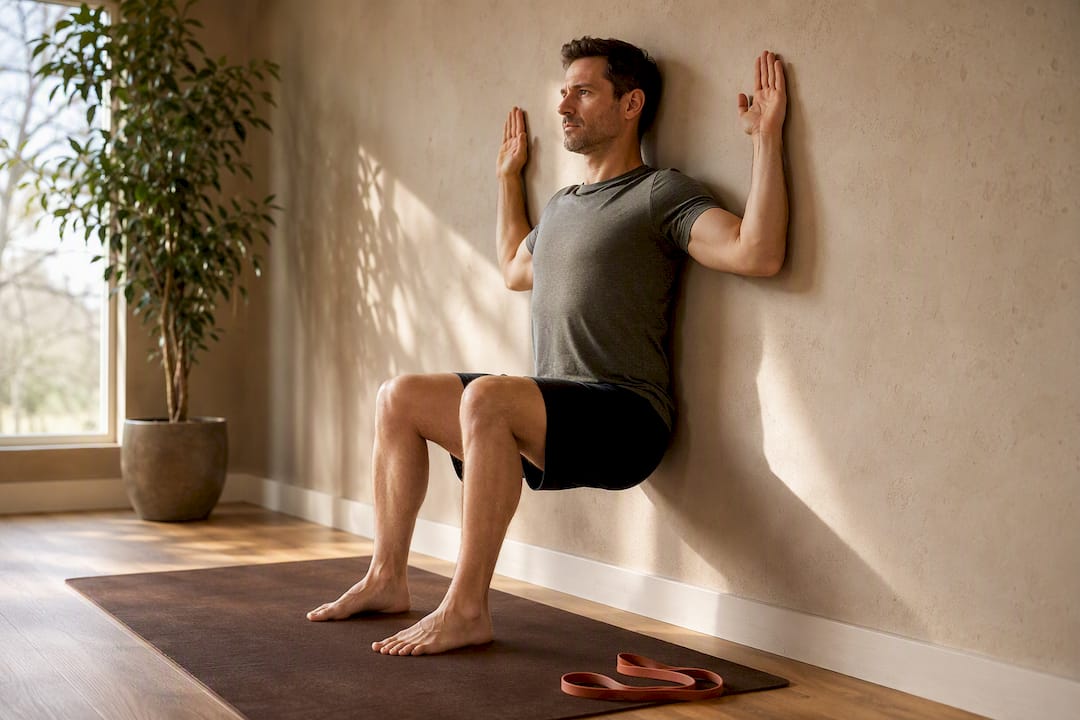
Wall angels. Stand with your lower back, upper back, and head against a wall, arms up in a goalpost position, forearms and backs of hands touching the wall. Slide your arms up and down while keeping contact with the wall, for 8 to 12 reps. Keep your shoulder blades flat rather than winging out. If your arms cannot stay on the wall, that is a mobility limit, not a failure, so step slightly away from the wall until you can maintain contact. Progress by slowing the tempo to 4 seconds up and 4 seconds down.
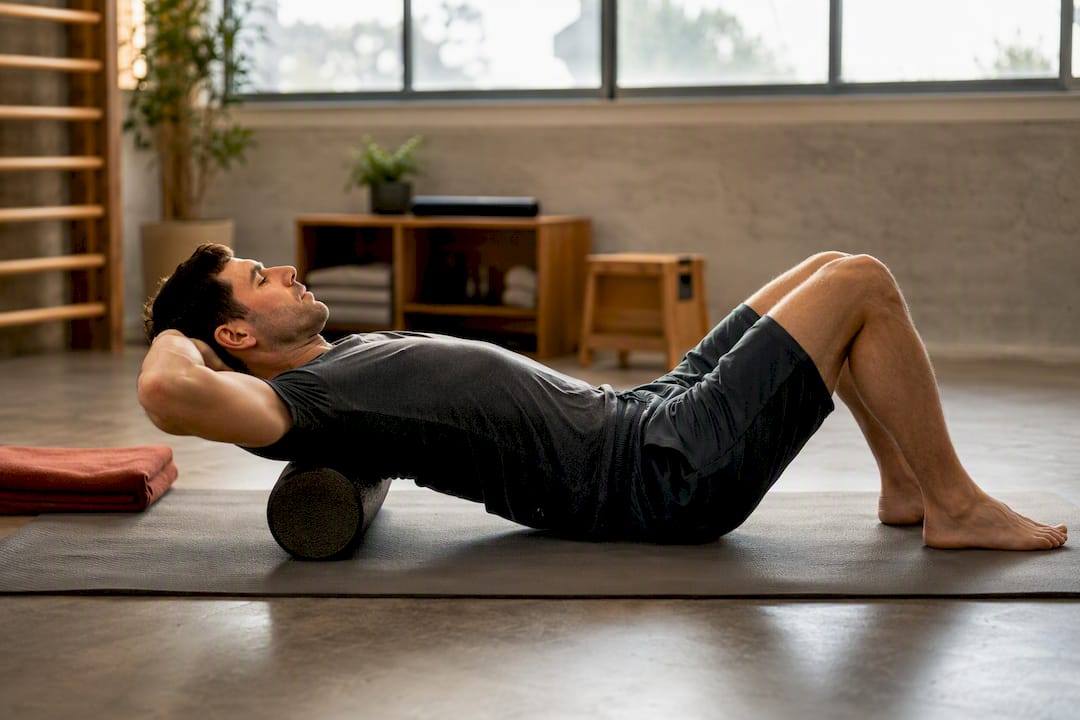
Thoracic extension over a foam roller or chair back. Place the roller (or a rolled towel) horizontally under your mid back, support your head with your hands, and extend backward over it, then curl forward slightly to reset. Do 8 to 12 reps, focused entirely on mid-back mobility rather than lumbar movement. This directly counters the hunched, rounded-forward posture that hours of screen time creates.
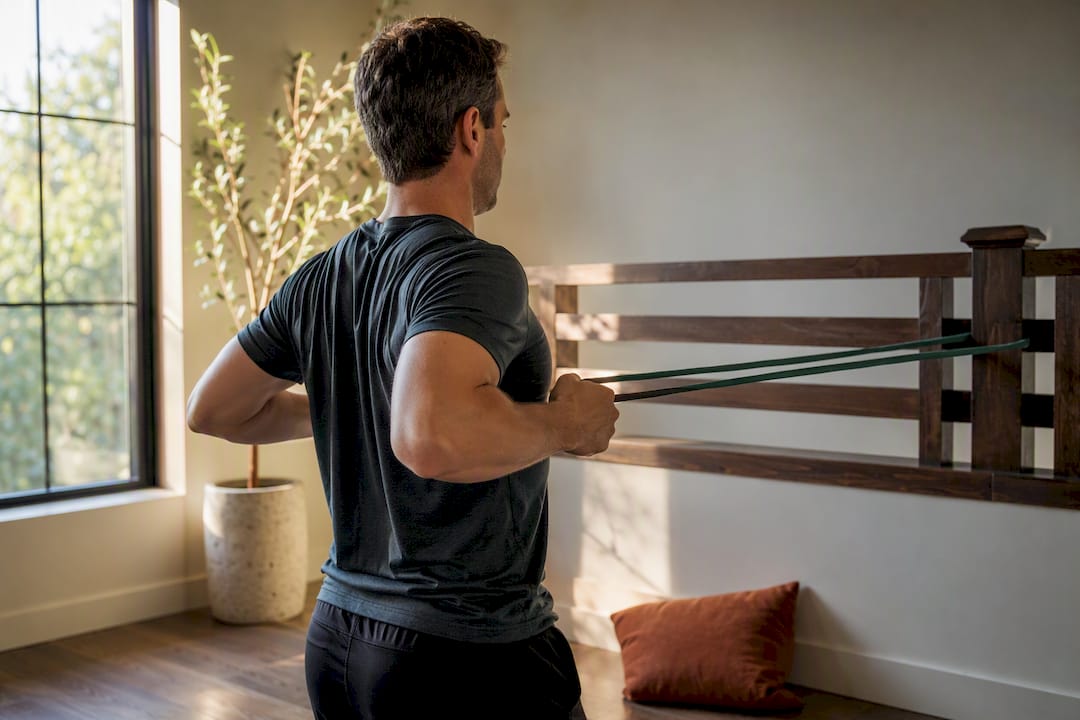
Scapular retraction and band rows. Anchor a light resistance band at chest height, pull your elbows back while pinching your shoulder blades together, and pause for a second at the squeeze. Run 2 to 3 sets of 8 to 15 reps. The cue that matters most: initiate the pull with your shoulder blades, not your hands.
Pectoral doorway stretch. Place your forearm on a door frame at roughly shoulder height, step forward gently until you feel a stretch across your chest, and hold 30 to 45 seconds. Repeat on the other side, then repeat the whole stretch with your elbow slightly higher or lower to hit different fibers of the chest muscle.
Pelvic tilt and glute bridge. Lying on your back, flatten your lower back into the floor by tilting your pelvis, then progress into a full bridge by driving your hips upward through your heels. Run 2 to 3 sets of 8 to 15 reps, cueing a hip drive rather than an arch through the lower back.
Plank and side plank. Hold a forearm plank starting at 20 seconds and building toward 60 seconds over several weeks. Keep your hips level, ribs pulled down, and avoid letting your lower back sag toward the floor, which is the most common error and the one that turns a core exercise into a lower back strain risk.
On equipment: a light band suits chin tucks and early rows; move to medium resistance once 15 reps feels easy; save heavy bands for rows once your form is solid. A rolled towel works as well as a foam roller for thoracic extension, and any sturdy door frame substitutes for a cable machine on the chest stretch.
Pro Tip: Do your chin tucks and thoracic extension before your strengthening moves, not after. Mobility work primes the muscles you are about to strengthen, so the strengthening exercises recruit the right muscles instead of letting your neck and shoulders take over.
Building a 4-Week Posture Correction Plan
Random effort gets random results. A short, repeatable weekly structure gets you further than an ambitious routine you abandon after four days.
Sample weekly plan:
Every weekday: one 5-minute desk break routine, done at least twice
Monday, Wednesday, Friday: the full 10-minute strengthening routine
One rest or light mobility-only day, no strengthening required
4-week progression:
Week 1: Learn the movements. Focus entirely on form, not intensity. Chin tucks at 10 reps, plank at 20 seconds.
Week 2: Add reps. Chin tucks to 15, plank to 30 seconds, introduce light band resistance on rows.
Week 3: Add hold time. Isometric holds on chin tucks, plank pushed to 45 seconds, band tension moves to medium.
Week 4: Add volume. A second set on rows and bridges, plank at 60 seconds, doorway stretch hold extended to 45 seconds.
Track more than how you feel. Take a side-profile photo against a doorframe each week and check whether your ear lines up over your shoulder. Run a simple symmetry check: stand relaxed and note whether one shoulder sits noticeably higher than the other. A basic mobility test, like reaching both arms overhead without arching your lower back, tells you whether your thoracic mobility is improving.
On the timeline, the systematic review evidence behind these programs shows statistically significant improvement in forward head posture and rounded shoulders. Most people doing a structured program like this notice reduced stiffness within a few weeks and visible alignment changes within several weeks. That is consistent with what most physical therapy clinical guidance describes as a realistic window for soft tissue adaptation.
When to Stop and See a Clinician
Muscle soreness and mild stiffness the day after a new exercise are normal. Sharp, shooting, or worsening pain is not, and it means you back off immediately rather than pushing through.
Watch for these signs that self-directed exercise is not enough on its own:
Numbness or tingling running down an arm or into the hand
Progressive weakness in a hand, arm, or leg
Pain that is severe, constant, and does not ease with rest
Sudden changes in your walking pattern, balance, or bladder or bowel control
Sharp pain during a specific movement rather than a general stretch or work sensation
If an exercise causes sharp pain, do not simply grit through it. Reduce your range of motion, lower the resistance, or slow the tempo before trying again. If pain continues even with those changes, drop the exercise entirely for now.
Postural kyphosis and persistent mechanical neck pain are two situations where clinical best-practice guidance commonly recommends hands-on care alongside exercise rather than exercise alone. If you are unsure whether your pain fits that category, a resource like Meddle’s guide to allied health for back pain breaks down which type of provider handles which kind of case.
Why Combining Exercise With Hands-On Care Speeds Recovery
Exercise alone works. Exercise paired with hands-on care tends to work faster and hold longer. A study on chiropractic manipulative therapy of the thoracic spine found that combining spinal manipulation with targeted stretching and strengthening produced greater improvements in postural kyphosis than either approach used by itself.
That matches the broader pattern in corrective exercise research: programs that pair manual therapy with a structured exercise plan see better movement patterns and muscle activation than programs relying on exercise alone. An evidence-based clinic visit typically starts with an assessment of your specific postural pattern, moves into an exercise prescription tailored to what that assessment finds, and includes supervised progression so you are not guessing at reps and resistance on your own.
Posture is a story your body tells about years of habit, stress, and repeated movement. Reading that story accurately, then rewriting it, is where compassionate, patient-focused care changes the outcome.
An assessment by a healthcare provider is often the missing piece for people who have tried generic routines without lasting results. If you notice any of the red flags above, or you simply want a plan built around your own posture pattern, an in-person evaluation gives you a clearer starting point than guesswork.
What the Evidence Gets Right and Where Advice Falls Short
Most posture content online treats exercises like a checklist: do these five moves and your posture fixes itself. The research does not support that oversimplification. What it supports is consistency over intensity. The meta-analysis on therapeutic exercise shows results building over weeks of repeated, correctly performed work, not from one aggressive session.
Where conventional advice falls short is form correction. Plenty of guides list wall angels and chin tucks without warning readers about the two most common mistakes: tucking the chin down instead of back, and letting the lower back sag during a plank. Those errors do not just blunt results. They can reinforce the very compensation patterns you are trying to correct.
If I had to prioritize one thing, it is this: start with the 5-minute routine today rather than waiting for a “complete” 10-minute plan you can commit to perfectly. Momentum beats perfection here. And if pain or asymmetry persists past a few weeks of honest effort, that is your signal to get an assessment rather than adjust the routine yet again on your own.
— James
Sources
The systematic review and meta-analysis on therapeutic exercise for upper crossed syndrome provides the strongest evidence base for the exercises in this guide. The critically appraised topic on forward head posture identifies which specific exercises RCTs use most often. MedlinePlus’s guide to good posture offers plain-language, patient-facing daily habit advice. The chiropractic and exercise combination study supports the case for pairing hands-on care with a home routine.
The effect of various therapeutic exercises on forward head posture, rounded shoulder, and hyperkyphosis among people with upper crossed syndrome: a systematic review and meta-analysis
Evidence-Based Corrective Exercise Intervention for Forward Head Posture in Adolescents and Young Adults Without Musculoskeletal Pathology: A Critically Appraised Topic
Chiropractic manipulative therapy of the thoracic spine in combination with stretch and strengthening exercises, in improving postural kyphosis in woman
Recommended
Comments