
Relieve Text Neck in 2–4 Weeks with 5 Clinician Backed Exercises


Conservative care resolves most text neck cases: correct your posture, work through targeted strengthening exercises, and adjust your screen setup so your neck stops carrying extra load. Short-term relief comes from heat, ice, and over-the-counter pain relievers, plus movement breaks scattered through your day. If numbness, tingling, or weakness radiate into your arm, or nothing improves after a few weeks of consistent effort, it’s time to have a clinician take a look.
TL;DR:
Correcting posture and strengthening the muscles between the shoulder blades can improve neck alignment and reduce pain over several weeks.
Ergonomic adjustments, such as positioning screens at eye level and taking regular movement breaks, significantly decrease the load on neck muscles.
Initial relief is achievable with heat, ice, over-the-counter anti-inflammatories, and targeted exercises, but persistent symptoms warrant professional evaluation.
If numbness, weakness, or radiating pain into the arms occurs or symptoms do not improve after a month, consulting a healthcare professional is essential.
Consistent habits and physical therapy are key to preventing recurrence, with most people experiencing significant improvement within two to four weeks.
Table of Contents
What Causes Text Neck and What It Feels Like
We tilt our heads forward every time we check a phone, and that small tilt costs more than you’d think. At a 15-degree forward tilt, your neck muscles support roughly 27 pounds of load; tip to 45 degrees, the angle most of us hit while texting, and that climbs to nearly 49 pounds. Do that for hours a day, every day, and the muscles supporting your head start to fatigue and strain.
That repetitive load shows up as a familiar cluster of symptoms:
Aching or stiffness at the base of the neck and across the upper back
Tension headaches that build through the afternoon
Shoulder tightness or a “knot” feeling between the shoulder blades
Tingling, numbness, or aching that travels down one arm
Left unaddressed, this cycle of strain and micro-injury tends to become chronic pain. Your body adapts to the forward posture, which only compounds the load rather than resolving it.
Quick At-Home Relief You Can Try Today
You don’t need a clinic visit to start feeling better this afternoon. Match the tool to the problem: heat relaxes muscles that feel tight and knotted, while ice calms down a fresh flare of inflammation or a sharp, localized ache.
A short course of an over-the-counter anti-inflammatory like ibuprofen, or acetaminophen if your stomach doesn’t tolerate NSAIDs well, can take the edge off while you work on the underlying posture problem. Use it for a few days at most, follow the label’s dosing, and check with a pharmacist or doctor if you’re on other medications.
Apply heat for 15 to 20 minutes before stretching or exercising
Use ice for 10 to 15 minutes after activity that flares symptoms
Set a timer for movement breaks every 20 minutes when you’re at a screen
Roll your shoulders back, tuck your chin, and look up at the ceiling for a slow count of five
Pro Tip: If a stretch or exercise triggers new numbness, tingling, or a sharp shooting pain down your arm, stop immediately. That’s your body telling you to get evaluated rather than push through it.
Clinical guidance from Yale Medicine backs this exact approach: motion, posture correction, heat or ice, and short-term OTC medication as the first line of defense.
Best Exercises for Text Neck Relief
Stretching alone often isn’t enough, and in some cases it can backfire. When the muscles in your upper back are already weak, over-stretching the neck without building strength underneath it can leave you more unstable, not less. A scoping review of 15 studies on text neck physiotherapy found that programs combining postural correction with stabilization and strengthening work produced significant gains in range of motion and pain reduction. The goal is restoring a neutral alignment, and that means strengthening the muscles between your shoulder blades, not just loosening the ones in front.
Here’s a simple daily sequence to build that strength:
Chin tucks. Sit or stand tall, draw your chin straight back like you’re making a double chin, hold for 5 seconds, and repeat 10 times.
Scapular retractions. Squeeze your shoulder blades together and slightly down, hold for 5 seconds, repeat 10 to 15 times.
Prone scapular squeezes. Lie face down, arms at your sides, lift your chest slightly, and squeeze your shoulder blades together for 5 seconds; do 2 sets of 10.
Thoracic extension over a chair back or foam roller. Arch gently backward over the support for 20 to 30 seconds, repeat 3 to 5 times.
Wall angels. Back against a wall, arms in a goalpost position, slide them up and down while keeping contact with the wall, 10 repetitions.
Start with sub-maximal effort on the chin tucks and scapular squeezes for the first two to three weeks. Once pain settles down, you can layer in resisted scapular depressions and more aggressive thoracic extension work, a progression pattern the same scoping review supports for steady, low-risk gains.
Pro Tip: Do this routine at the same time every day, right after brushing your teeth or during a coffee break. Consistency matters far more than intensity here.
If any move sharpens your pain rather than easing it, back off the range of motion or drop the hold time before abandoning the exercise altogether.
Ergonomic Tips for Text Neck That Actually Work
Exercise fixes the muscles; ergonomics fixes the habit that damaged them in the first place. Skip one and the other only buys you partial relief.
Position your monitor 20 to 30 inches from your eyes, with the top of the screen sitting about a half inch to an inch and a half above eye level, according to ergonomic guidance from Stanford University. That setup naturally produces a gentle 15 degree downward gaze instead of the steep tilt that loads your neck.
A few more adjustments make a real difference:
Keep elbows bent near 90 degrees and feet flat on the floor or a footrest
Raise your phone to eye level instead of dropping your chin to it
Set a 20 minute reminder to stand, stretch, or simply change position
Try voice-to-text for long messages instead of hunching over a small screen
When reading on your lap, prop the device on a pillow or stand rather than holding it low
OSHA’s computer workstation guidance points to the same conclusion from a workplace-safety angle: micro-breaks and correct desk setup measurably cut musculoskeletal strain. Small, boring habit changes are what keep the pain from coming back.
When to See a Clinician and What to Watch For
Give conservative care a real trial, generally two to four weeks of consistent exercise and ergonomic changes, before deciding it isn’t working. Most people notice meaningful improvement in that window.
Certain symptoms deserve faster attention:
Pain, numbness, or tingling that radiates down an arm into the hand
Progressive weakness in your grip or arm
Any change in bowel or bladder function
Severe, unrelenting pain that doesn’t ease with rest or position changes
If you hit one of those red flags, or conservative care simply stalls, a chiropractor can evaluate spinal alignment and joint mobility, a physical therapist can build out a supervised strengthening program, and a primary care physician can rule out other causes or refer you to a specialist when something more is going on.
Clinical Treatment Options Beyond Home Care
When home exercises plateau, physical therapy is usually the next step, and it’s the option with the strongest research behind it. That same 2025 scoping review found supervised postural correction and strengthening programs produced measurable improvements in both pain and range of motion.
Other clinician-delivered options fill different roles:
Chiropractic adjustment and manual therapy address joint restriction and can improve mobility alongside an exercise program.
Adjunct modalities like ultrasound, electrotherapy, and red light therapy don’t replace strengthening work, but they can calm symptoms enough to make exercise more tolerable.
Injections or nerve blocks are reserved for persistent, specifically diagnosed nerve irritation that hasn’t responded to weeks of conservative treatment.
Surgery is rare and limited to cases with confirmed structural nerve or spinal cord compression.
Recovery timelines vary, but many people feel noticeably better within a few weeks of steady effort. That said, nearly half of people with neck pain see it recur without a lasting behavior change, which is exactly why the exercise and ergonomic pieces matter as much as any single treatment.
How Compassion Chiropractic Approaches Text Neck
When someone walks into Compassion Chiropractic with the classic signs of text neck, we start with a real assessment, not a generic protocol. We look at posture, mobility, and where the strain is concentrated, then build a personalized plan around restoring strength and alignment rather than chasing symptoms.
Alongside hands-on chiropractic adjustment, we offer adjunct therapies like Vibroacoustic therapy, red light therapy, ultrasound, and electrotherapy to support the rehab work your body is already doing. None of these replace the exercises. They’re there to make the recovery process a little more comfortable while your strength rebuilds.
How Clinicians Diagnose Text Neck
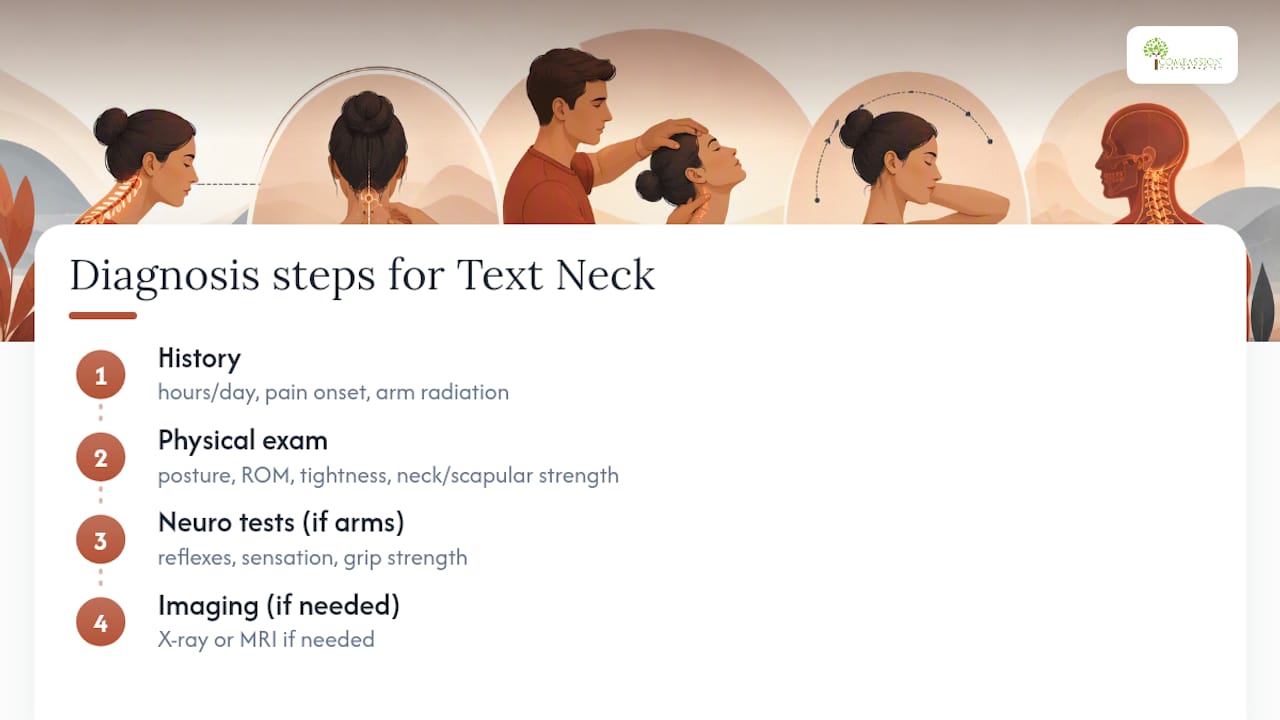
A clinician evaluating neck pain from device use starts with a history: how many hours a day you’re on a screen, when the pain started, and whether anything radiates into your arms or hands. That last detail matters enormously, because it separates simple muscular strain from a nerve-related problem that needs a different treatment path.
Next comes a physical exam. A chiropractor or physical therapist will check your posture standing and seated, looking specifically for a forward head position and rounded shoulders. They’ll test your cervical range of motion in all directions, feel for muscle tightness or trigger points across the upper back and neck, and check the strength of your deep neck flexors and scapular stabilizers, since weakness there is a hallmark of text neck.
If arm symptoms are present, clinicians often add neurological tests: checking reflexes, sensation, and grip strength to see whether a nerve root is being irritated where it exits the spine. Special orthopedic tests, like compressing the top of the head while the neck is tilted to one side, can help reproduce or rule out nerve-related pain on the spot.
This assessment matters because text neck symptoms overlap with other conditions, including cervical disc issues, tension headaches unrelated to posture, and even shoulder joint problems that refer pain up into the neck. Imaging like X-rays or MRI isn’t usually needed for straightforward cases, but a clinician may order it if red flag symptoms appear or if conservative care isn’t producing the expected results. Getting the diagnosis right up front saves you weeks of guessing.
Stress, Mindset, and Recovery From Text Neck
Muscle tension doesn’t only come from posture. Stress physically tightens the muscles across your neck, shoulders, and upper back, often the exact muscles already strained from hours of looking down at a screen. That means a stressful week at work can make text neck symptoms feel worse even if your screen habits haven’t changed at all.
There’s also a behavioral piece worth naming honestly. Experts who study text neck point out that exercises and physical therapy mostly manage symptoms while the underlying habit, extended downward gazing, continues unchanged. You can do every chin tuck perfectly and still see symptoms creep back if the phone habit that caused them in the first place never changes. Recovery isn’t only physical. It requires a genuine shift in how you hold your device and how long you stay locked into that posture each day.
Simple stress management supports the physical work rather than replacing it. Slow, deep breathing for a few minutes during your movement breaks can loosen the shoulders and neck along with calming your nervous system. Noticing when you clench your jaw or hunch your shoulders during a stressful call is a useful habit in itself. If anxiety or chronic stress is a bigger factor in your life, addressing it, through counseling, exercise, or simply better sleep, tends to pay off in fewer flare-ups and faster recovery from the physical symptoms.
Lifestyle Changes That Support Healing
How you sleep matters almost as much as how you sit at your desk. Sleeping on your stomach forces your neck into a rotated position for hours, which can undo a full day of good posture work. Side or back sleeping with a pillow that supports the natural curve of your neck, rather than tilting your chin up or down, gives those strained muscles a real chance to recover overnight.

Beyond sleep, look at the small activity patterns that add up across a day. Carrying a heavy bag on one shoulder repeatedly, cradling a phone between your ear and shoulder during calls, or sitting in a slouched position on the couch for hours all feed the same forward-head pattern you’re trying to correct at your desk. None of these need to disappear from your life. They just need enough attention that they don’t quietly cancel out your exercise routine.
Building general movement into your day, a walk at lunch, stretching before bed, standing up during phone calls, gives your whole postural system more variety than a single static position ever will. The Mayo Clinic Health System points to exactly this pattern: long stretches in one static position, whatever that position is, tend to drive the strain that becomes text neck. Recovery sticks best when it’s supported by a whole day of varied movement, not just twenty minutes of exercises squeezed in before bed.
A Note From James
Most people who commit to a few weeks of consistent exercise and ergonomic changes feel real relief. Start the routine above today, adjust your screen setup this week, and if progress stalls, don’t wait months to have someone take a closer look.
— James
Ready to Book an Assessment at Compassion Chiropractic?
If you’ve tried the exercises and ergonomic fixes above and you’re still stuck, walking into a clinic beats guessing at what’s wrong on your own. The clinic operates on a walk-in model offering personalized chiropractic care, allowing patients to receive evaluation without a long wait.

Your first visit typically includes a hands-on assessment of your posture, neck mobility, and upper-back strength, the same factors we walked through in the diagnostic section above. From there, we build a rehab plan around chiropractic adjustments and supportive therapies like stretching and rehabilitation programs, tailored to how long you’ve had symptoms and how your body responds to movement. Bring a list of your symptoms, when they started, and what’s helped so far. The clinic uses a fee-for-service model with flexible payment options to help make care accessible, so cost should not delay getting checked out.
Book your assessment online and take the next real step toward getting your neck out of that forward-tilted position for good.
Sources
This article is general information, not a substitute for advice from a qualified doctor. Consult a qualified healthcare professional about your own circumstances before acting on anything here.
FAQ
Is It Possible to Fix Text Neck?
Yes. Most cases improve significantly with a combination of posture correction, targeted strengthening exercises, and ergonomic changes to screen setup, according to a 2025 scoping review of physiotherapy interventions.
Is Text Neck Reversible?
For most people, yes, especially when caught before symptoms become chronic. Consistent chin tucks, scapular strengthening, and reduced downward gazing can restore a more neutral head position over weeks to months.
How Can Text Neck Syndrome Be Treated?
Treatment centers on conservative care: heat or ice for symptom relief, targeted exercises like chin tucks and scapular retractions, and ergonomic fixes like raising your screen to eye level. A walk-in assessment at Compassion Chiropractic can help if symptoms don’t improve on their own.
How Long Does It Take to Get Rid of Text Neck?
Many people notice improvement within two to four weeks of consistent exercise and posture changes, though full recovery depends on how long symptoms have been present and how strictly screen habits change. Without lasting habit change, symptoms can recur even after they initially improve.
Recommended
Comments