
Save After 5 Sessions: U.S. Ultrasound Therapy Cost and Billing Checklist


A single clinic session typically runs $30 to $100, with CPT 97035 (the billing code for therapeutic ultrasound) carrying a median cash price near $74. A full course of 8 to 20 sessions often lands between a few hundred dollars and $1,500 or more. At-home devices cost $100 to $400 upfront and break even fast if you need ongoing care. Short-term or insured? Choose the clinic. Chronic and recurring? A device, or a hybrid of both, usually saves you money over time.
TL;DR:
Many clinics charge between $30 and $100 per session, with a median of about $74 per 15-minute unit, and treatment plans can cost up to $2,220.
Insurance varies widely, with Medicare often reimbursing less predictably than commercial payers, and patient costs depend on billed charges, allowed amounts, and deductibles.
At-home ultrasound devices costing $100 to $400 typically break even after 3 to 8 sessions, making them cost-effective for ongoing treatment over time.
Always request a written Good Faith Estimate before treatment to avoid surprise bills, especially if out-of-network or uninsured.
Table of Contents
How Does Insurance Change What You Pay for Ultrasound Therapy?
How Long Does a Full Ultrasound Therapy Treatment Plan Take?
What Other Costs Should You Budget for Beyond the Session Price?
Why Does Ultrasound Therapy Cost So Much More in Some Areas?
Ready to Get a Real Number? Book Your Ultrasound Therapy Visit
How Much Does Ultrasound Therapy Cost at a Clinic?
Here’s where compassion meets math, because understanding your bill starts with understanding the code behind it. Clinics bill therapeutic ultrasound under CPT code 97035, defined as ultrasound treatment to one or more body areas, billed in 15-minute units. That single detail changes everything about your final bill. A 30-minute session isn’t one charge. It’s two units. A 45-minute session is three. If your provider bills unit by unit, your total climbs with every quarter hour on the table.
The National Benchmark: Published hospital self-pay data across thousands of facilities puts the median cash price for CPT 97035 at $74 per unit, with the middle 50% of prices falling between $45 and $111.
Consumer pricing research backs this up, showing that typical single sessions run $30 to $100 depending on region and provider. Multiply that across a full treatment plan and the numbers start to matter:
An 8-session plan at the low end ($30/session) totals around $240.
An 8-session plan at the median ($74/unit) totals roughly $592.
A 20-session plan at the high end ($111/unit) can reach $2,220 or more.
Those totals rarely tell the whole story, though. Many hospital price lists reflect facility charges only, meaning the professional fee for the therapist or chiropractor administering treatment shows up as a separate line item. Before you commit to a plan, ask your provider three things: whether the quoted price includes both facility and professional fees, which CPT codes will actually appear on your bill, and whether they can issue a written Good Faith Estimate. Under federal price transparency rules, uninsured and self-pay patients can request this estimate before treatment begins, and it’s one of the simplest ways to avoid a surprise invoice later.
How Does Insurance Change What You Pay for Ultrasound Therapy?
Insurance turns a flat price into a moving target, and that’s precisely why so many patients feel blindsided at the register. Medicare reimbursement for CPT 97035 tends to run lower and more predictably than commercial insurance, while commercial payer allowed amounts vary widely from one carrier and region to the next. Two patients with the same diagnosis and the same clinic can walk away owing very different amounts.
Three numbers determine your actual cost, and they’re not the same thing. The billed charge is what the clinic lists before any negotiation. The allowed amount is what your insurer has agreed to pay for that service. Your patient responsibility, whatever’s left after your deductible, copay, or coinsurance kicks in, is the number that actually lands on your statement.
Before your first appointment, work through this short checklist:
Call your insurer and ask specifically about coverage for CPT 97035.
Ask your provider whether ultrasound is billed separately or bundled with other therapies.
Confirm whether prior authorization is required for your plan.
Request a Good Faith Estimate in writing, especially if you’re uninsured or seeing an out-of-network provider.
Pro Tip: Watch for billing structures where a facility quotes one price for the “session” but bills ultrasound, electrical stimulation, and manual therapy as three separate line items on the same visit. Ask upfront how many distinct codes will appear on your bill, not just what the visit “costs.”
Are At-Home Ultrasound Devices Worth the Cost?
For patients managing a chronic condition, buying your own device can feel like an act of faith in your own healing, and often it pays off financially. Consumer portable ultrasound units typically retail between $100 and $400, with combination devices that add TENS or red light therapy priced in a similar range.
These are not the same machines your chiropractor uses. Clinical-grade equipment operates at different power outputs and frequencies than portable home units, and that gap exists for good reason. Clinical devices are calibrated for specific dosing protocols under licensed supervision, while home units are built with lower intensity ceilings for safety in unsupervised settings. That doesn’t make a home device useless. It means a home device is built for maintenance and comfort, not for replacing diagnosis or complex post-operative care.
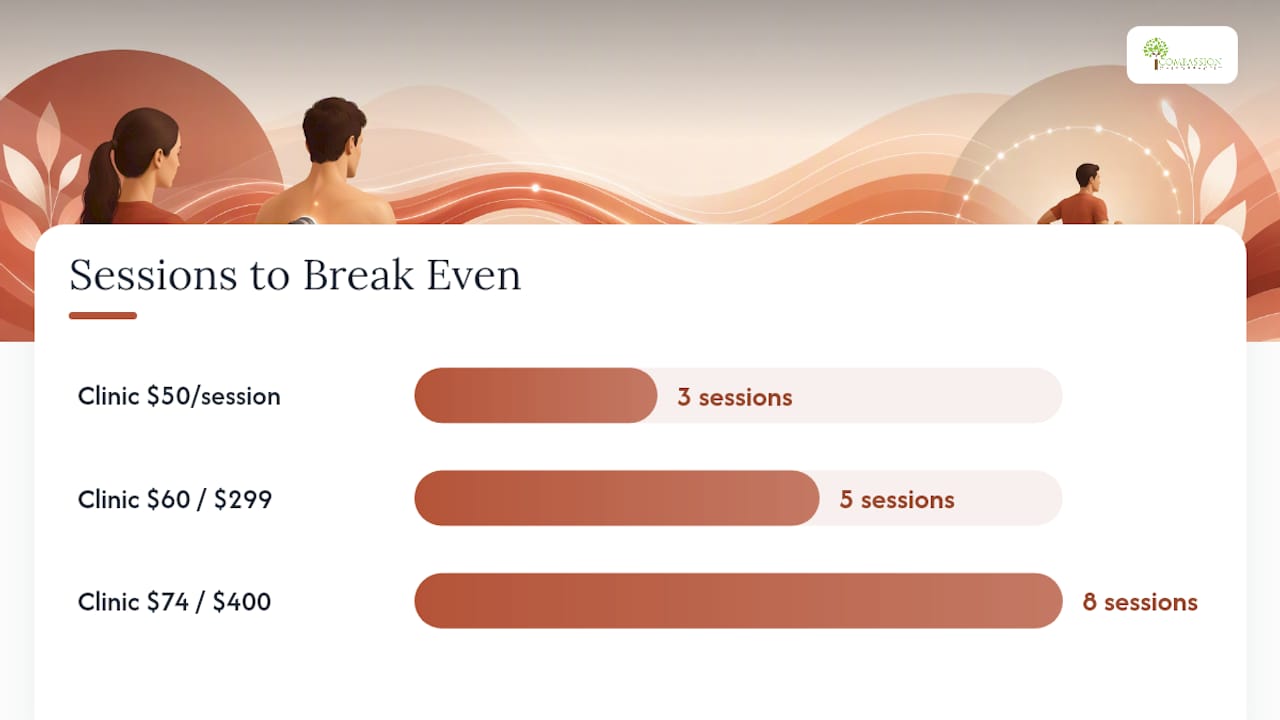
The break-even math is refreshingly simple:
Take the device price (say, $299).
Divide by your typical per-session clinic cost (say, $60).
The result is roughly how many sessions it takes to break even, about 5 in this example.
Device Price | Clinic Cost Per Session | Sessions to Break Even |
— | $50 | 3 |
$299 | $60 | 5 |
$400 | $74 | 8 |
If your treatment plan calls for more sessions than that, a device often pays for itself within a month or two. Before buying, check the unit’s FDA classification, talk to your chiropractor about whether regular home use fits your condition, and ask your HSA or FSA administrator whether the device qualifies for reimbursement if prescribed.
Clinic, Home Device, or Both? How to Decide
The right answer depends less on price and more on how your body actually responds to treatment over time. A short-term injury with an insurance plan behind it usually favors the clinic. Chronic, recurring pain that requires ongoing management often favors a device, or a hybrid where you start under clinical supervision and transition to home maintenance.
Weigh these questions before you decide:
How many sessions will you realistically need, and how often?
Does your condition require a clinician’s diagnostic eye, or just consistent, gentle maintenance?
Does your insurance cover in-clinic ultrasound, and at what patient responsibility?
Can you get to a clinic reliably, or does transportation make home treatment more practical?
If buying a device, does it carry a warranty, a return policy, and clear documentation of its FDA classification?
A patient recovering from surgery needs supervised care first. Someone managing years of lower-back tightness may do better starting in-clinic, then adding a home device once their chiropractor confirms it’s appropriate.
What Compassion Chiropractic Offers for Ultrasound Therapy
We built Compassion Chiropractic on a simple conviction: healing shouldn’t wait on red tape or a fat wallet. Since 2009, our walk-in model has let neighbors get seen without a scheduling maze standing between them and relief.
Our ultrasound therapy sessions are one piece of a broader holistic approach that includes electrotherapy, rehabilitation, and personalized chiropractic adjustments. What you can expect when you visit:
A hands-on assessment before any therapy begins, so treatment matches your actual condition.
Clear communication about what a session involves and how it fits into your broader care plan.
A fee-for-service model with options for different payment arrangements.
Patient stories and outcomes are shared on the site.
Call ahead or walk in. Either way, ask us for a written estimate before you commit.
How Long Does a Full Ultrasound Therapy Treatment Plan Take?
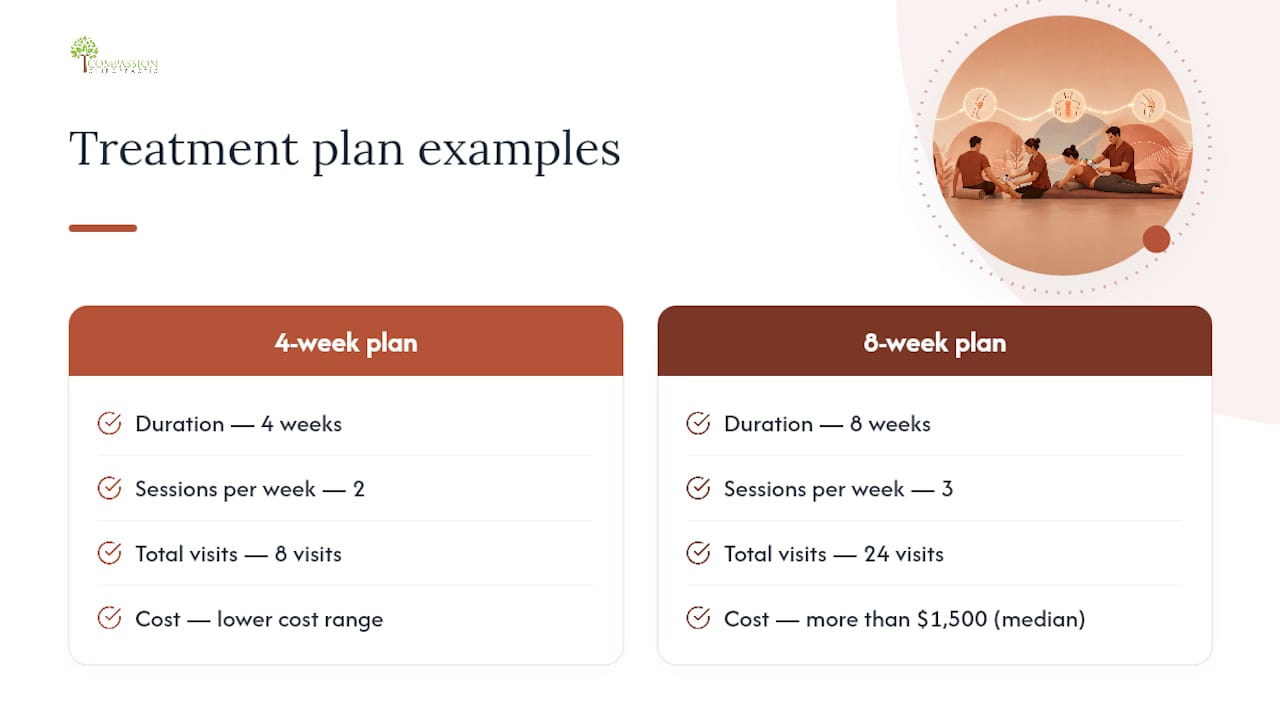
Healing has its own timeline, and rushing it rarely serves the patient. Most treatment courses stretch across several weeks, not a single afternoon. A typical plan often includes multiple sessions per week over several weeks, with simpler soft-tissue complaints sometimes resolving after several sessions, while more persistent or chronic conditions may require more sessions or an extended course of care. Your chiropractor will typically reassess progress every few visits, adjusting frequency based on how your tissue responds rather than sticking to a rigid preset number.
This matters for your budget as much as your body. A four-week plan at two sessions weekly means 8 total visits, land squarely in the lower cost range we outlined earlier. Stretch that to eight weeks at three sessions weekly, and you’re looking at 24 visits, pushing your total cost well past $1,500 at median pricing. Ask your provider early how many sessions they anticipate and how they’ll measure progress, so the financial picture doesn’t outpace your expectations.
What Other Costs Should You Budget for Beyond the Session Price?
The quoted per-session price is rarely the whole bill, and pretending otherwise sets patients up for disappointment. Most treatment plans start with an initial consultation or evaluation visit, often billed separately from the ultrasound sessions themselves, to establish diagnosis and a care plan.
Follow-up visits add another layer. Chiropractors typically reassess progress periodically, and those check-ins may carry their own charge even when no ultrasound is administered that day. If your condition responds better to a combined approach, your provider may also recommend complementary therapies, electrotherapy, manual adjustment, or vibration acoustic therapy, stacked onto the same visit.
Before your treatment plan starts, ask specifically whether the following are included in your quoted price or billed separately: the initial evaluation, periodic reassessments, any complementary modality added mid-treatment, and equipment or supply fees if applicable. A Good Faith Estimate should capture all of this in writing, not just the ultrasound line item. Patients who skip this step are the ones most likely to open a bill three weeks later and wonder where an extra $200 came from.
Why Does Ultrasound Therapy Cost So Much More in Some Areas?
Geography does more to your bill than almost any other factor. A hospital-affiliated clinic in a major metro area often carries higher overhead, and that cost gets reflected in what they charge for the same 15-minute unit of therapeutic ultrasound that a small independent practice in a rural town might bill at half the price.
Provider qualifications shift the price too. A session administered by a licensed physical therapist or chiropractor in a specialized rehabilitation setting may carry a different fee structure than the same technology used in a general wellness clinic. Clinic type matters just as much: hospital outpatient departments frequently bill higher facility fees than independent chiropractic offices, even when the actual treatment looks identical on paper.
None of this means higher price equals better care. It means the market for this treatment is fragmented, shaped by local real estate costs, staffing models, and whether a facility bills as part of a larger hospital system or as a standalone practice. Your best defense against overpaying is comparison. Call two or three providers in your area, ask for their CPT 97035 rate, and request a written estimate before you book.
An Honest Look at What This Cost Data Actually Tells You
Most cost guides on this topic hand you a price range and call it a day. That’s not enough. If a quote comes in well above $111 with no explanation, that’s your cue to ask why, not to assume it’s simply the going rate.
The bigger blind spot in most advice is the false choice between “clinic” and “home device.” Session frequency is the real variable that should drive your decision, not brand loyalty to one method. Someone needing twice-weekly maintenance for a chronic issue is doing the math wrong if they never price out a $299 device against months of $60 copays.
What I’d prioritize first: get the written Good Faith Estimate before your first visit, regardless of which path you choose. It’s the one tool that turns a vague price range into an actual number you can plan around.
— James
Ready to Get a Real Number? Book Your Ultrasound Therapy Visit
You’ve seen the ranges, the codes, and the break-even math. What you probably want now is a straight answer for your own situation, not another spreadsheet. Compassion Chiropractic has offered walk-in, donation-friendly care since 2009, built around getting you assessed and treated without weeks of waiting or opaque billing.

Call ahead or stop by, and we’ll walk you through what your ultrasound therapy session involves and what it will actually cost, in writing, before treatment starts. Have your insurance card and any prior imaging or provider notes on hand so we can move quickly. If a full plan feels overwhelming, we offer a suggested-donation option for patients working through financial hardship. Ready to get a real number for your situation? Book your visit online or explore our full range of services to see how ultrasound therapy fits into your broader care plan.
This article is general information, not a substitute for advice from a qualified doctor. Consult a qualified healthcare professional about your own circumstances before acting on anything here.
Sources
Recommended
Comments