
Office Workers: 4 Steps to Fix Upper Cross Syndrome in the Right Order


Upper cross syndrome is a postural pattern where tight chest and neck muscles pull against weak upper back and deep neck muscles, dragging your head forward and rounding your shoulders. The most effective response is a staged program (release the tight muscles first, then stretch, then strengthen, then retrain daily habits) combined with real changes to how you sit and work. If numbness, progressive weakness, or unrelenting pain shows up alongside the posture changes, see a clinician instead of self-treating.
TL;DR:
Overactive muscles like the upper trapezius and pectorals pull the shoulders forward, while weak muscles like deep neck flexors and mid-back stabilize the posture.
Consistent stretching and strengthening exercises, following the release-stretch-activate-integrate sequence, are proven to improve posture and reduce pain over several months.
Short-term manual therapy can help release tight tissues and make active rehab more tolerable, but it cannot replace a dedicated exercise program.
A proper home routine takes about 15 minutes and should be performed four to five times a week to see noticeable improvements.
Improving workstation ergonomics and taking movement breaks are crucial for long-term prevention and maintenance of correct posture.
Table of Contents
What Does Upper Crossed Syndrome Look Like?
Physical therapist Vladimir Janda described this as an “X” pattern: tightness across the back of the neck and chest crosses diagonally with weakness in the upper back and deep neck flexors, pulling the whole upper body out of alignment. The visible result is a forward head position, shoulders that round inward, and sometimes a shoulder blade that wings away from the ribcage instead of sitting flat.
Upper cross syndrome symptoms tend to build gradually rather than appear overnight. Expect a dull ache at the base of the skull, tension headaches, tightness across the upper back that never fully releases, and a noticeable drop in how far you can turn or tilt your neck. Many people notice it first when someone points out how far their chin juts forward in photos.
Why Does Upper Cross Syndrome Develop?
The pattern almost always traces back to hours spent in a forward-head position. Looking down at a phone, hunching toward a monitor, or leaning into a steering wheel for long commutes all train the same muscle imbalance over and over, and the body eventually adapts to that shape as its new baseline.
Certain jobs accelerate it faster than others. Desk-based roles that involve typing with rounded shoulders, dental and surgical work that demands sustained forward leaning, and driving-heavy occupations all layer repetitive strain onto the same muscle groups. A stiff thoracic spine makes it worse, because when the mid back can’t extend properly, the neck and shoulders compensate by rounding even further forward.
A few everyday habits quietly feed the same pattern:
Carrying a heavy shoulder bag or backpack on one side for years
Sitting for most of the day with minimal walking or resistance training
Sleeping with several pillows that push the neck into flexion
Skipping any upper back strengthening while stretching only the chest
Which Muscles Are Tight and Which Are Weak?
The imbalance always runs in two directions at once, so fixing one side without the other rarely holds. On the tight, overactive side, you’re usually dealing with:
Upper trapezius (the muscle that shrugs your shoulders toward your ears)
Levator scapulae (running along the side of the neck)
Pectoralis major and minor (pulling the shoulders forward and inward)
Sternocleidomastoid and scalenes (front and side neck muscles)
On the weak, underactive side, the usual suspects are the deep neck flexors, middle and lower trapezius, serratus anterior, and rhomboids. These muscles are supposed to hold the shoulder blades flat and the chin gently tucked, but chronic disuse lets them go quiet. The tight muscles win the tug-of-war, and every reach, lift, or overhead motion happens through a shoulder blade that isn’t properly anchored.
How Do You Know If It’s Something More Serious?
A few self-checks give you a rough read before you ever see a clinician. Try tucking your chin straight back without tilting your head down; if that motion feels blocked or your neck aches immediately, that’s a sign of deep neck flexor weakness. Check whether your shoulder blades sit flat against your ribcage in a mirror, and test how far you can rotate your neck side to side compared to before.
A clinician goes further, running motor control tests, a neurologic screen, and specific measures of scapular stability to rule out other causes. Certain symptoms warrant an appointment rather than another week of stretching:
Numbness or tingling that spreads down the arm and worsens over time
Noticeable weakness in the hand or arm, not just tightness
Severe pain that doesn’t ease with rest or position changes
Fever, unexplained weight loss, or other symptoms unrelated to posture
What Does the Evidence Say About Treatment?
Fixing upper cross syndrome works best in a specific order: inhibit and release the overactive muscles first, then lengthen them with stretching, then activate the weak ones, and finally integrate better patterns into daily movement. Skipping straight to strengthening without releasing the tight muscles first is one of the most common mistakes, and it tends to stall progress because the nervous system keeps defaulting to the old, dominant pattern.
The research backs this staged approach. A narrative systematic review covering 11 studies, including 10 randomized controlled trials, found that multi-component exercise programs reduce pain and improve both posture and neck-related disability in people with this pattern. That review specifically calls out craniocervical flexion exercises, the small chin-tuck motion that retrains the deep neck flexors, as a key piece of restoring normal muscle recruitment.
Here’s what the evidence actually supports:
Exercise-based programs combining stretching and strengthening consistently outperform passive rest or stretching alone
Craniocervical flexion drills specifically help suppress overactive neck muscles and rebuild deep flexor control
Manual therapy and soft-tissue work provide short-term symptom relief that makes active rehab more tolerable, not a standalone fix
Programs that skip the release phase and jump to strengthening show slower or stalled progress
Manual therapy has a real role here, but it’s a bridge, not a destination. Techniques like stretching-focused mobilization or adjunctive ultrasound therapy can quiet down guarded, overactive tissue enough that you can actually perform the activation exercises with decent form. Without that step, some people simply can’t tolerate the strengthening work.
Timeline matters for staying motivated. Most people notice less tension and better range of motion within two to four weeks of consistent practice. Actual postural change, the kind visible in a photo, takes months of steady work, not days. Thoracic stiffness deserves attention too, since treating only the tight chest muscles while ignoring a locked-up mid back is a near-guaranteed path to relapse.
Sample Routine: A Step-by-Step Home Program
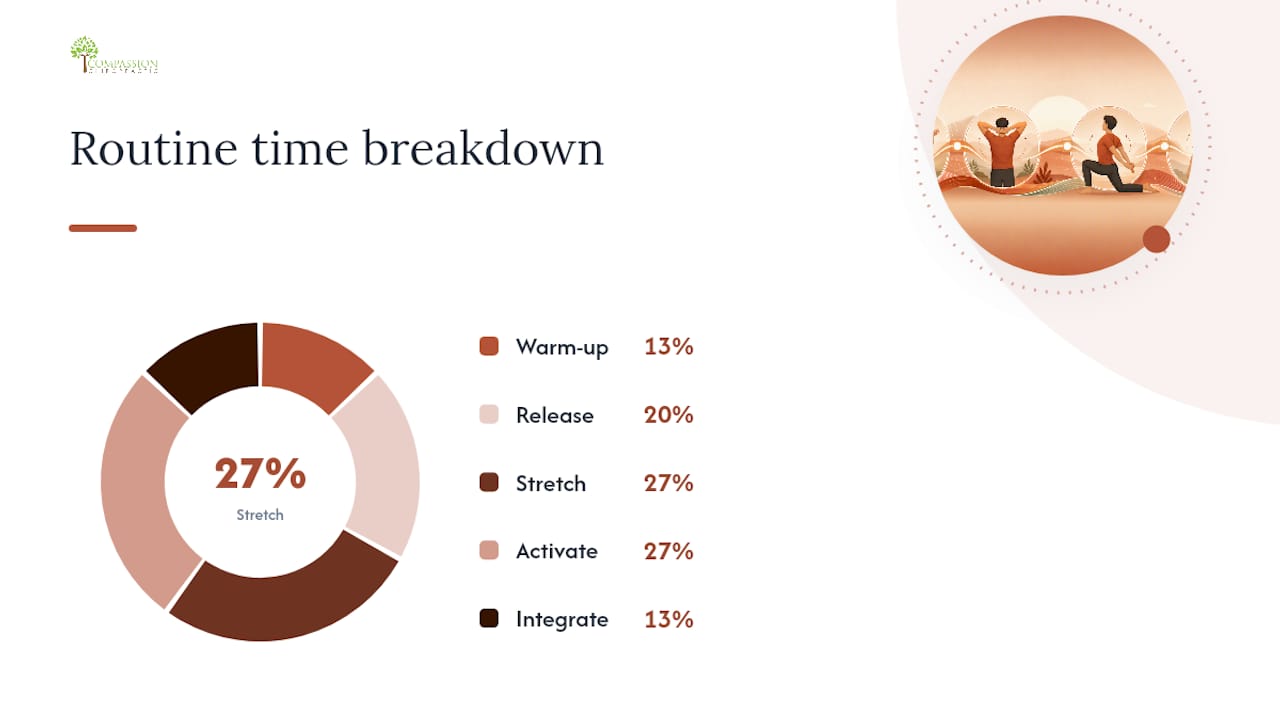
This sequence follows the release, stretch, activate, integrate order, and it takes about 15 minutes.
Warm up (2 minutes): Foam roll the upper back and gently roll your shoulders and neck through their available range.
Release (3 minutes): Apply light pressure with a tennis ball or foam roller to the upper traps and levator scapulae for 30 to 60 seconds per side.
Stretch (4 minutes): Hold a doorway pectoral stretch and a levator scapulae stretch (ear toward the opposite armpit) for 30 seconds each, two rounds per side.
Activate (4 minutes): Perform craniocervical flexion (a gentle chin nod) for 10 reps, then wall slides and prone “Y” raises for the lower trapezius, 10 reps each. Regress by doing fewer reps with shorter holds if your neck fatigues quickly; progress by adding a light resistance band once the basic pattern feels controlled.
Integrate (2 minutes): Set your shoulder blades back and down, then repeat a functional task, like typing or reaching for a shelf, while holding that position consciously.
Do this four to five times a week. Beginner mobility sequences like those in this yoga flexibility guide pair well with the release and stretch phases if you want extra variety.
Pro Tip: Set a timer for your integration step. The exercises matter, but the moment you forget your posture reaching for a coffee mug is exactly the moment the old pattern creeps back in.
How Do You Stop It From Coming Back?
Your workstation setup does more long-term work than any single exercise. Set your monitor at eye level, keep elbows around 90 degrees, let your wrists rest neutral rather than bent, and use a chair with real lumbar support. Small adjustments here remove the constant pull that created the imbalance in the first place.
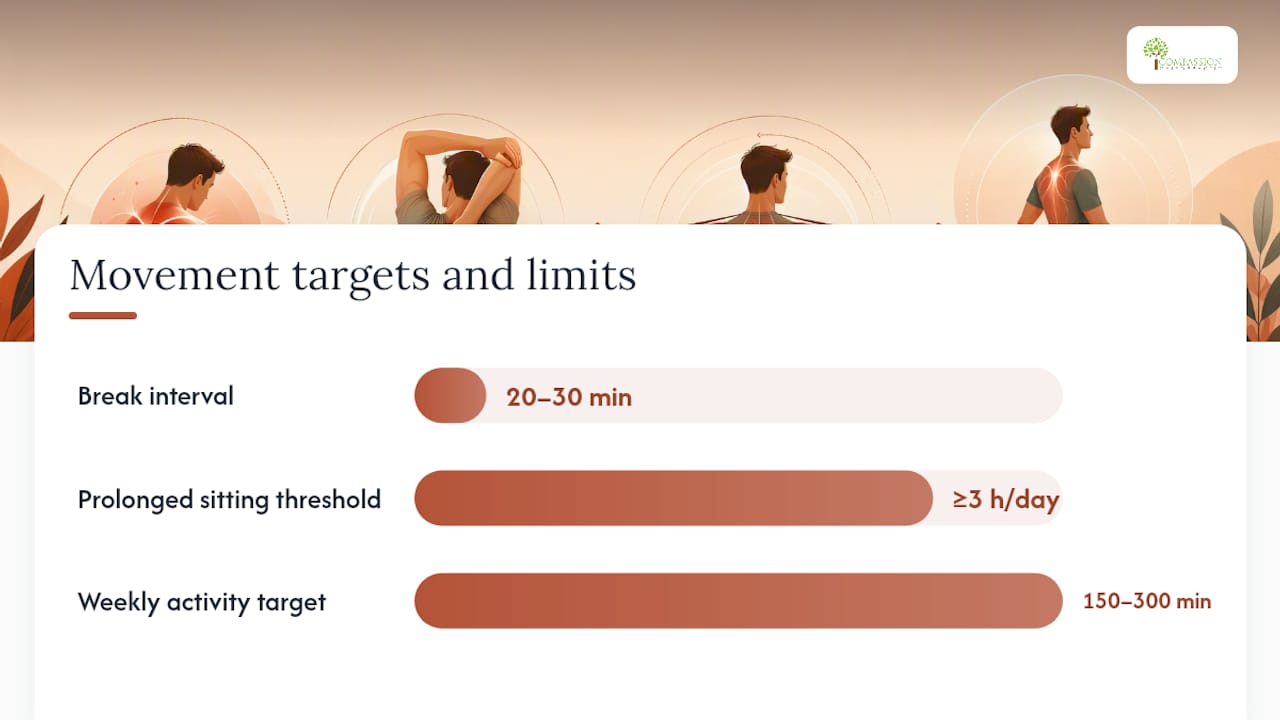
Movement breaks matter just as much as the setup. Prolonged sitting for three or more hours a day is linked to higher rates of neck and shoulder pain, so build in a short break every 20 to 30 minutes, even if it’s just standing up and rolling your shoulders back a few times.
Beyond the desk, general movement habits matter:
Aim for 150 to 300 minutes of moderate activity weekly, per posture and movement guidance
Alternate which shoulder carries a bag, or switch to a backpack
Recheck your posture during phone use, not just at your desk
Revisit your pillow setup if you wake up with neck stiffness
How We Approach Upper Cross Syndrome at Compassion Chiropractic
We see this pattern constantly, and it rarely improves through stretching alone. What tends to work is the same staged approach outlined here: calming down overactive tissue, rebuilding strength in the muscles that went quiet, and then checking in every few weeks to make sure workstation habits are actually holding. If your home program stalls or you notice any red-flag symptoms, an in-person assessment through our services can find what’s actually driving the imbalance.
— James
If you’ve worked through the home program for several weeks without real change, or if pain keeps interrupting sleep and daily tasks, it’s worth having a hands-on evaluation rather than guessing further. Book an appointment at Compassion Chiropractic in Palm Bay, and we’ll build a plan around what your body is actually doing, not just what the textbook pattern predicts.
This article is general information, not a substitute for advice from a qualified doctor. Consult a qualified healthcare professional about your own circumstances before acting on anything here.
Sources
Recommended
Comments